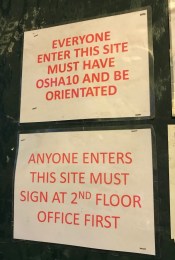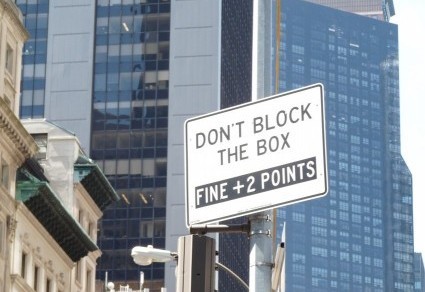
Regarding the title of this post: “Twenty,” because that’s the number trending on signs around town. “Something,” because the message of each of these signs means something. I just don’t know what. Take this sign (please, please take it away):

I like a discount as much as the next person, but I’m a little hesitant to buy a “damaged boxes item.” And no, there was nothing under or near the sign to give me context. No damaged boxes, no item.
Here I know what they’re selling, sort of, but there’s still a problem:

Actually, several problems. Once you say “Coca-Cola,” doesn’t that narrow things down, making “beverage” redundant? Are there Coca-Cola sandwiches? Cookies? (Forget I asked. I don’t want to know.) My real issue is with “200Z,” which looks like a serial number. Given the nearby illustration of more sugary beverage than anyone should ever drink, I’m assuming that “200Z” needs a space, as in “20 OZ,” the abbreviated form of “20 ounces.” I’m not sure whether the pizza crust and sauce under the pair of cheese slices are included in the $5.95 price, but at least the store inserted the hyphen correctly.
I saved the best (actually the worst) for last:

If you hope to meet a regular customer, your odds are 4 out of 5, I guess, because “today” has “20% new clients.” Actually, new “client’s.” I was tempted to erase the hyphen with my sleeve, but I can’t spend all day deleting apostrophes from NYC signs. I have better things to do, like figure out what the shop offers. The part I glimpsed through the window left me clueless. Besides, the sign may be referring to something belonging to the 20%, in which case the possessive is appropriate. The only problem, aside from the fact that there’s no indication of what’s possessed, is that the apostrophe should appear after the letter S (the plural form), because “20%” implies more than one person. They can’t chop up one person! I think at least twenty-something percent of us can agree on that point.


I pass this store often, so I can report with confidence that every forklift has a “literature packet” strapped to its vertical shaft. I’ve spent a lot of time speculating about the contents of the “literature packet,” wondering what genres are represented and whether the literature changes with the seasons. This being autumn, I’d choose Frost’s “After Apple-Picking” or “This Is Just to Say” by William Carlos Williams, possibly the best poem ever written about food larceny. (It’s the one where the speaker confesses that he has “eaten the plums” that someone was “probably saving for breakfast.”) Or maybe the packet contains the script of “Babette’s Feast” or the Christmas dinner scene from Great Expectations. Yes, I know, the “literature” is probably operating instructions, but a grammarian can dream, can’t she?
According to the dictionary, a “drove” is “a herd or flock” or “a large mass of people acting in unison.” Therefore, “Zimbabweans” can turn out in “droves,” but not “Zimbabwe.” Unless a mass of countries with that name somehow didn’t make it onto the map?
As far as I’m concerned, BOGO all you want. I once thought that the concept of “buy one get one” was an unnecessary statement of the standard deal between buyer and seller. But now I see that most BOGO-users are too busy surfing social media to add an “F,” for “free.” Or maybe they think that BOGOF sounds like a mediocre brand of caviar. I commend this sign-writer for specifying the terms of the deal, spelling out “buy one get one” for “50% Off,” though strictly speaking the sign should read “BOGAOF50%O” (buy one get another one for 50% off). I concede that such a sign resembles the kind of password people concoct and promptly forget. I will, however, raise an objection to “tight.” I prefer to cover both legs with “tights,” not just one with a “FREE tight.” And $75 is a little steep, don’t you think?


Somehow “ped” got a period, but “dept” didn’t. Both are abbreviations, “ped” being the shortened form for “pedestrian” and “dept” for “department.” In case you’re wondering (actually, despite the fact that you’re not wondering at all), I should mention that this NYC “dept” isn’t consistent when it comes to punctuation relating to walkers:

I understand that consistency is difficult to achieve in, say, a 200-page document. But if you’re working with only two sentences, you ought to be able to spare a period for each or omit the punctuation mark entirely.
Okay, no period at the end of this sentence: I’m used to that. But I can’t find any reason for a comma before the conjunction “or.” For that matter, I can’t find a reason for the text as written. Why not just say “DO NOT FEED BIRDS”? Theories welcome. Punc also.
I support the plea, the lavatory version of the Golden Rule, but not the pronoun. As the sentence is worded, “it” has to refer to “stalls and sinks.” Those items are clearly plural, and “it” is singular.