Tag Archives: punctuation

Em and Ens

$1.5 billion. Sounds like a lot of money, doesn’t it? That’s the settlement of a class-action suit filed against Anthropic, a company that downloaded pirated copies of books, including fifteen of mine, to train its artificial intelligence software. When I heard $1.5 billion I hyperventilated for a few minutes. Then I read the fine print. Attorneys get paid first, and publishers will have a share. My portion, converted into coins, is likely to fit inside a medium-sized piggy bank. Still, I’m pleased that a blow has been struck against dishonesty.

Many more suits have been filed against AI companies, but I doubt any will include their effect on the em dash, the longest of the three punctuation marks formed with a horizontal line. Written material containing an em dash is now assumed to be AI-generated. In a weird way, that assumption makes sense. AI was “trained” by professional writers’ work. We use em dashes. Hence, so does AI. But as a professional, em-dash-using writer, I’m caught in a loop: my work looks like my work and therefore resembles AI-generated work designed to mimic my work. Kafka, meet Chat GPT.

Now for the en dash, a slightly shorter line that signifies a strong connection. Sometimes the connection is geographical, describing, say, a train route between Boston and New York. Sometimes it’s personal, referring perhaps to the coordination between pitcher and catcher. Most often, the en dash functions chronologically:

That’s what it’s doing on the stone-paneled wall of a churchyard in my neighborhood. Each slab is incised with a name and a set of dates. A life span! The en dash expresses the strong — in fact, absolute — connection between birth and death. A couple of panels, belonging to the ultra-prepared, show only one date and the en dash, waiting to be completed by an unknown, though certain expiration date. If the em dash has come to signify inhumanity (for what else is artificial intelligence?), the en dash expresses the ultimate truth about humanity. Everyone born will die.

Before the en dash comes for you, I recommend you make the most of every moment — for yourself, and for a world that needs all the help it can get.

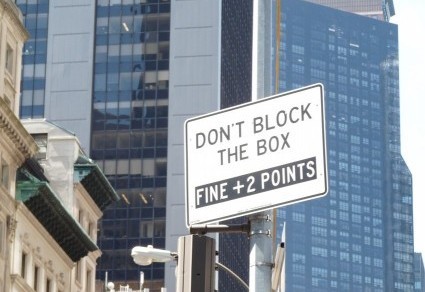
Speaking of the world, I have an update to share. Take a look at this photo, which I snapped outside the United Nations in 2015:

For a decade, drivers had to decide which sign to obey — STOP or NO STOPPING. But now all the signage has replaced. NO STOPPING is what drivers are supposed to do. Which means that if the traffic light next to the NO STOPPING sign is red, you should blow right through the intersection. Well, nobody’s perfect.

Something’s Missing

Every once in a while I see a sign that’s missing something: a letter, a word, a punctuation mark, or, all too often, clarity. Consider this notice, which was chalked on an old-fashioned sandwich board near the entrance to a rather fancy (i.e. expensive) food store near me:

I’ve cropped the photo, but nothing I removed answers this question: Place your party platters & cake where? The sign appeared at the beginning of a holiday season, so presumably the store was hoping for advance notice instead of a same-day request to rescue a host who invited 235 people to a celebration despite having only two olives and a bottle of champagne in the refrigerator. Which I’m pretty sure in my neighborhood is not all that rare. My sympathy is with the sign-writer, who neglected to squeeze the word “order” into the message.

This notice, which my friend Andie sent me, is missing an important definition:

I’m guessing the store doesn’t want to Refund any money to its customers. But what does Redone mean? (And why are Refund and Redone capitalized?) If I buy a salad and report that it’s a bit vinegary, for example, will the store rinse off the leaves and apply new dressing?

I’ve held onto this sign for a while, trying to decide whether it’s an insult to neighbors (RESIDENT TRASH) or an attempt to fend off TRASH that turned tourist and went sightseeing inside this bin:

Theories welcome.

I doubt I’ll ever patronize this establishment:

Some crucial information is missing from this sign: How deep are the cuts? Are we talking scalp-scrapes or decapitation? Also, do the police know?

My late husband spotted this sign some years ago, in a major-appliance store that went out of business soon after he snapped the photo:

What’s missing from this label, of course, is a list of the food that comes with w/ this Refrigerator. Is it stuffed with macadamia nuts and caviar or leftovers from the manager’s lunch?

All joking aside, we’re all missing something these days. Whatever you’re missing, I hope you find it!

Tiny Marketing

What’s the opposite of “mass marketing” — the attempt to reach as many customers as possible and (unofficially) to bloat my email spam folder? I’m calling it “tiny marketing” — the attempt to reach a specific sort of consumer. Very specific.

Take this store, for example:

I was not surprised to see a going-out-of-business sign show up in the window of this shop. After all, they were marketing to one KID (indicated by the apostrophe’s position before the S) instead of to all AMERICAN KIDS, for which they’d need to place the apostrophe after the S.

The audience for this sign is also rather small:

Opera singers who are into DUMPING GARBAGE into an ARIA — how many can there be?

I truly don’t know how many vehicles this sign addresses:

Question: When you’re riding on ALT BUSES, what sort of alt rock is piped in? May I suggest Nirvana and the Foo Fighters? Maybe a little U2?

This product could have wide appeal, but somehow I doubt it:

I’m not sure I’d ever want my portrait painted, but if I did, I wouldn’t want Abraham Lincoln looming over me. I’d rather be in a canvas by myself.

One last photo, with no-question-about-it mass appeal:

Unless you want Shower Caps that ensure wet hair, this product’s for you. I imagine that’s all of us. I know that’s all for this post. Happy first day of summer!

Help Wanted

I’m not hiring. I’m reacting to the fact that pretty much everyone I encounter these days is tense about extreme weather, extreme politics, and, of course, the holiday season. Like The Beatles, “I get by with a little help from my friends.” But if you prefer a different method, perhaps one of these signs will suggest a path forward. Here’s one I saw in Madrid, Spain:

Poetry and psychoanalysis! A dynamite combination for personal growth and tension relief.

If poetry and psychoanalysis aren’t for you, consider the advice offered by the Irish Times in 1916, when martial law was declared in Dublin. With violence in the streets and a strict curfew, the newspaper opined:

Trouble outside, poetry inside! Wonderful thought, and a strategy that more than a few people, myself included, followed during the Covid lockdown era. Okay, maybe not the Bard, but trashy novels for sure.

Still looking for help? Here’s a sign in Seatac Airport:

I’m not sure why the sign maker felt the need to mention both Rescue and Assistance. Perhaps it’s because when things are really bad, one is not enough?

What if nothing is enough, and you’re still tense from doom-scrolling? Don’t give in! Or, as a zoo in Seattle put it:

My interpretation: It’s not the wolves’ fault! Pick your targets wisely. And maybe read a little poetry to the pack.

West Coast Woofers

I’ve spent the last few weeks in Seattle, which has been called “a city that loves books” because of the large number of bookstores, libraries, and book sales there. How lovely to be in a city of readers! Even more impressive: it appears that not all of Seattle’s readers are human. Take a look:

I wonder whether any members of the bark-set have objected to the missing punctuation.

Speaking of the bark-set:

Pay attention, Fido! Keep quiet, Rex! You don’t want a tow-away to the (gasp!) pound. (And yes, there’s some red tape stuck on the sign. I didn’t stick it there. If I had, the sign would have been much sloppier.)

These homeowners are less threatening , more polite, and probably just as earnest about their request to neighborhood dogs:

Be respectful“: now that’s a message I can support!

Moving on from woofers, here’s an excerpt from a plea for kitten adoption:

While Squirrel’s profile appeals on many levels (who can resist feather wand toys?), I balk at living with a cat that loves to eat a chorus, no matter how out of tune the singers’ performance may be.

I choose to believe there’s hope for Squirrel. If West Coast Woofers can read, they can teach Squirrel to resist noshing on a tenor. Maybe they can even persuade the human population — not just in Seattle but everywhere — to be respectful. That would be something to bark about, even in a tow-a-way area.

No Easy Fix

I generally get snarky when I see a odd turn of phrase, as everyone who has read this blog knows. Sometimes, though, I go into editor mode. How would I reword? Occasionally I’m stumped, as I was when this teaser popped up on my screen:

Books you should watch? I don’t think so! But if you move this description to follow TV shows, you solve one problem only to create another, because now you’ve got TV shows you should watch based on books. This version makes me think of viewers perched atop (based on) stacks of books. Also, in your lifetime implies there’s another viewing option. Does heaven offer streaming services?

Here’s a photo my friend Constance sent. It’s a advertisement for Coppola’s, an Upper West Side restaurant. Pay close attention to the bottom left:

If I were painting that sign, I’d place the apostrophe — well, I don’t know where I’d place it! Apostrophes and vertical words don’t easily coexist. Move the apostrophe one line up, after the A, and the S comes across as an afterthought. Drop it completely and you break a punctuation rule. What to do?

Another location problem:

The surf that was used for D-Day? Nope. The Allies didn’t take a surf from a damp warehouse and install it at the landing site. The best rewording I can come up with is developed a method used on D-Day for predicting the size of the surf — not a catchy phrase, for sure.

Okay, readers. It’s your turn. Revision suggestions welcome!

If at first you don’t succeed . . .

“If at first you don’t succeed, try, try again.” This old adage advocates not only persistence but also repetition. And unlike many counselors, the adage follows its own advice, doubling up on try. Is repetition a good idea in signs? I’ll let you decide after you take a look at these.

Jenny, a student in my writing class at Hugo House (www.hugohouse.org), sent me this one:

Technically this sign isn’t repetitive, because PRICE changes to Prices as the font grows. Why? That’s a puzzle, as is the whole sign. What’s with all the empty space and the solitary O? And why repeat? Perhaps for emphasis: “Hey, customer, we really mean it!” Maybe to scold: “Had you listened the first time, we wouldn’t have to tell you again.” Either way, the punctuation in the last line is a problem. Quotation marks most often indicate the reproduction of someone’s exact words. However, quotation marks can also distance the quoter from the quotation, the visual equivalent of a wink and a nod: “We say LOW PRICE but we actually charge double. And just try cashing in on our GUARANTEE!” A third possibility is that the sign writer followed the recent trend that employs quotation marks as attention-getters. I’m not happy with that usage. It’s hard enough, these days, to separate fact from fiction.

Moving on, here’s a sign I spotted in a dry-cleaning shop:

Why make two statements about PERC? Correct me if I’m wrong, but isn’t NO PERC ODOR a given when there’s NO PERC? Or does someone sell PERC ODOR to people who enjoy chemical smells but don’t want the liver and kidney damage that PERC brings?

This sign’s repetition is the least of its problems:

So they BUY . . . CASH for CA$H? Good to know, though I’m left wondering what the exchange rate is when you convert CASH to CA$H. What really bothers me, though, is the offer to TURN YOUR OLD BOY FRIENDS JEWELRY INTO CA$H. If the statement has something to do with ownership, it should read BOYFRIEND’S JEWELRY or, for someone with an active dating life, BOYFRIENDS’ JEWELRY (the plural possessive). Do I have to point out that turning someone else’s adornments into CA$H is theft? Worse than the apostrophe error is the possibility that AND might be missing from the space between FRIENDS and JEWELRY. Even if you hate your OLD BOYFRIENDS, you can’t swap them for CA$H. You really can’t!

On that stern note, I’ll say BYE BYE for today.

Accuracy

A large number of signs advertise products or services of extraordinary value — or so they’d like you to believe. These more modest and likely more accurate signs are a refreshing counterpoint. First up is a notice posted on a building undergoing renovation:

Who indeed! I’d like to hire that contractor for my next project. The work may drag on, but at least I’ll have advance warning.

Next is a restaurant sign:

PRETTY HEALTHY FOOD is good enough for me, and probably more nutritious than more pretentiously labeled fare (artisanal, handcrafted, bespoke, etc.)

This merchant, like George Washington, cannot tell a lie:

Sign up for this EXCLUSIVE OFFER and receive ten letters, one per month, from the likes of George Washington and John F. Kennedy. The photo quality isn’t great, so I’ll retype the key phrase here: ORIGINAL REPRODUCTION. I’m not entirely sure what that means, but I’m glad the seller hasn’t robbed the National Archives or hired ghost writers. Actual ghosts, given the dearly departed status of the authors.

Last, and anything but least, is this correction issued by a media outlet in late 2020, before Kamala Harris took office:

Who knew that punctuation was audible to this degree of accuracy? I applaud the writer’s devotion to truth, really. Let me rephrase: I applaud the writer’s devotion to truth. Really.

In Praise of Pickiness

Punctuation: very small marks governed by a very big set of rules, many of which don’t even have the grace to stay the same from one country to another. Caring about hyphens and apostrophes takes pickiness to a new height, doesn’t it? Yet I can’t help wishing that someone had edited these headlines and labels a little more carefully.

I dare you to decode this one on first reading:

I’ve read it several times, as well as the accompanying article, and I still don’t know who’s who and where they are. I get that someone’s in-house and someone’s at home, and I’m sure that neither is Nureyev, the ballet superstar who died in 1993. Also, why hyphenate in-house? A small consolation is that the apostrophe is used correctly. Not so in this label:

I don’t know how many coffee beans are in the jar, but I do know that I don’t want to be our (or anyone’s) guess. Nor do I want to make 3 guess’s.

If only I could poach the apostrophe from guess’s and insert it below:

Your more? Advertiser, you’re better than that! And if you’re not — well, call me picky, but in that case I’d rather be just a number.

Technical Difficulties

I’ve been thinking about technical difficulties lately, perhaps because I’ve had a few. When I sat down to write this post an hour ago, for example, Word Press was down. It came back more quickly than my bank account, which went into a tizzy after someone tried to access it fraudulently. No harm done in either case, fortunately. I’m not sure the same is true at this shop:

First of all, this situation is unfair to anyone without a credit card or an item to barter. Second, what’s TECHNICAL about CASH? You put your hand out, someone puts the money in it, and you’re done. Okay, there’s recordkeeping, but are their pencils having TECHNICAL DIFFICULTIES, too?

This sign, sent by my friend Catherine, has another sort of technical problem:

Granted, it’s not too hard to figure out the identity of the missing letter — though I spent an enjoyable half hour imagining alternatives, such as FIRE DOOD (alternate spelling for the Big Lebowski), FIRE MOOD (blazing? glowing?) and FIRE GOOD (arsonist’s motto). What intrigues me is why just one letter is missing. Do the other letters have more stamina? Did the flames hop from the E in FIRE to the next word? Maybe it’s something about W. That’s one of my initials, but I promise you I didn’t swipe the letter. I can’t vouch for my relatives, though. My best guess is that there were technical difficulties with the glue.

Whoever issued this press release in December 2020 is unlikely to accept a flimsy excuse about technical difficulties. Read it carefully:

Swapping a period for the comma after inaugurated: Now that’s precise editing! The next time I encounter technical difficulties, I want the person who corrected the pool report on my team.