Travel is enlightening — but also befuddling. Having just returned from vacation, I’m reliving my adventures by examining signs I spotted during this trip and others. I find myself more confused than ever. Here’s a sign posted on the window of a school in Venice:

Three lines are simple to decode: They teach English, French, and German. But what’s Inglese Postcoloniale? My translation app says “Postcolonial English.” Okay, which colony are we talking about? America after the Revolutionary War? Britain after the Empire morphed into the Commonwealth? A variety of English spoken in former Italian colonies?
Next is a sign my family spotted in Tokyo:

Does the collision occur only when the pedestrian is oncoming, or is an outgoing collision also possible?
Judging from this sign, pedestrians in London should certainly proceed with caution:

I’m all for Road Safety in London (and everywhere else), but killing pedestrians For your own Safety seems counterproductive.
Amid the confusion, I did find one perfectly clear sign:

Bravo, Madrid! Bravo, hotel owner! Even the most jet-lagged travelers, assuming they speak English, can understand this message. Would that all our communications were so easily decoded!
No decoding needed for this message: I wish you happy travels, on the road and in your dreams.


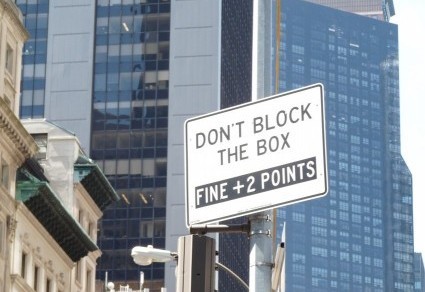
 Somehow “ped” got a period, but “dept” didn’t. Both are abbreviations, “ped” being the shortened form for “pedestrian” and “dept” for “department.” In case you’re wondering (actually, despite the fact that you’re not wondering at all), I should mention that this NYC “dept” isn’t consistent when it comes to punctuation relating to walkers:

 I understand that consistency is difficult to achieve in, say, a 200-page document. But if you’re working with only two sentences, you ought to be able to spare a period for each or omit the punctuation mark entirely.
 Okay, no period at the end of this sentence: I’m used to that. But I can’t find any reason for a comma before the conjunction “or.” For that matter, I can’t find a reason for the text as written. Why not just say “DO NOT FEED BIRDS”? Theories welcome. Punc also.


