Category Archives: Picky Punctuation Points

How punctuation changes or destroys meaning

Twenty Something

Regarding the title of this post: “Twenty,” because that’s the number trending on signs around town. “Something,” because the message of each of these signs means something. I just don’t know what. Take this sign (please, please take it away):

I like a discount as much as the next person, but I’m a little hesitant to buy a “damaged boxes item.” And no, there was nothing under or near the sign to give me context. No damaged boxes, no item.

Here I know what they’re selling, sort of, but there’s still a problem:

Actually, several problems. Once you say “Coca-Cola,” doesn’t that narrow things down, making “beverage” redundant? Are there Coca-Cola sandwiches? Cookies? (Forget I asked. I don’t want to know.) My real issue is with “200Z,” which looks like a serial number. Given the nearby illustration of more sugary beverage than anyone should ever drink, I’m assuming that “200Z” needs a space, as in “20 OZ,” the abbreviated form of “20 ounces.”  I’m not sure whether the pizza crust and sauce under the pair of cheese slices are included in the $5.95 price, but at least the store inserted the hyphen correctly.

I saved the best (actually the worst) for last:

If you hope to meet a regular customer, your odds are 4 out of 5, I guess, because  “today” has “20% new clients.” Actually, new “client’s.” I was tempted to erase the hyphen with my sleeve, but I can’t spend all day deleting apostrophes from NYC signs. I have better things to do, like figure out what the shop offers. The part I glimpsed through the window left me clueless. Besides, the sign may be referring to something belonging to the 20%, in which case the possessive is appropriate.  The only problem, aside from the fact that there’s no indication of what’s possessed, is that the apostrophe should appear after the letter S (the plural form), because “20%” implies more than one person. They can’t chop up one person!  I think at least twenty-something percent of us can agree on that point.


Happy Halloween!

Before or after you hit the trick-or-treat trail, take a minute to enjoy  these holiday photos. This one comes from my friend Milton:


“Punking” seems perfectly suited to the “trick” part of the Halloween slogan, don’t you think?

Mary Shelley’s famous novel, Frankenstein, is also a good fit for this holiday. The Morgan Library has a fine exhibit celebrating the 200th anniversary of the monster, who, by the way, has no name and is actually much less monstrous than most of the human characters in the book. (Frankenstein is the name of the doctor who sewed body parts together and animated the creature.) I learned a lot from the exhibition, including this information about early theatrical performances of the classic work:

Leave it to Mary Shelley, inventive in so many ways, to add an apostrophe and the letter S to a row of hyphens to create a possessive form of “the unnameable.”

Once Halloween is over and you’re fighting sugar rush and paying dental bills, you might plan for another holiday, one that tends to be stressful. Show this sign — sent by my friends Pilar, Naomi, and Aracelly — to any of your unruly offspring:

“Behave or I’ll drop you off.” Simple but effective! But before your kids call Children’s Protective Services, be sure to explain that you’re just punking them.

I Give Up

After decades of bellyaching about the sad state of NYC signs, I have officially given up  — on some issues, not on all. Grammarian in the City will no longer object to the following:

As far as I’m concerned, BOGO all you want. I once thought that the concept of “buy one get one” was an unnecessary statement of the standard deal between buyer and seller. But now I see that most BOGO-users are too busy surfing social media to add an “F,” for “free.” Or maybe they think that BOGOF sounds like a mediocre brand of caviar. I commend this sign-writer for specifying the terms of the deal, spelling out “buy one get one” for “50% Off,” though strictly speaking the sign should read “BOGAOF50%O” (buy one get another one for 50% off). I concede that such a sign resembles the kind of password people concoct and promptly forget. I will, however, raise an objection to “tight.” I  prefer to cover both legs with “tights,” not just one with a “FREE tight.” And $75 is a little steep, don’t you think?

I’ve also thrown in the towel when it come to hyphens:

My first glimpse of this truck made we wonder whether Bunsen burners are prone to out-of-control blazes. If so, I thought, there is certainly a need for “scientific-fire prevention.” But perhaps this company pursues customers who prefer that the laws of physics take priority in battling flames? That meaning would call for “scientific fire-prevention.” Whatever. I’m done with fulminating about hyphenating.

Nor will I say one word about the silliness of this sort of sign:

Okay, just a couple of words: Is there anyone who believes that amateurs rent stores, buy equipment, and have signs painted so that they can repair “hand-bags,” zippers,” and “luggage”?  Judging from the trend to specify “professional” dry-cleaning, barbering, and other services, I guess the answer is yes. No matter. I don’t care. I can even live with this sign’s reference to moribund footwear (“dying” not “dyeing”).

Inaccurate acronyms, missing hyphens, and dead shoes:  This “professional” grammarian has given up on them all.

Punc. Puzzles

What governs whether a sign-maker has room for letters and punctuation? Font? The size of the sign? I’m going for chaos theory, based on these signs. The first is from the “Dept of Transportation”:

Somehow “ped” got a period, but “dept” didn’t. Both are abbreviations, “ped” being the shortened form for “pedestrian” and “dept” for “department.” In case you’re wondering (actually, despite the fact that you’re not wondering at all), I should mention that this NYC “dept” isn’t consistent when it comes to punctuation relating to walkers:


Maybe the plural “peds” seems different to the dept? Grammatically, it’s not.

Not only “depts,” but also building owners get creative with punctuation:


Neither of the two sentences on this sign ends with a period. Also, “owners” should have an apostrophe, before the s or after it, depending upon how many people own the bikes. I gave up the apostrophe battle a long time ago, so I won’t dwell on that issue here. I do wonder (a) how the landlord can figure out who owns a bike and (b) exactly how the “expense” is collected. I’m betting this sign is an empty threat. (Also ineffective, given the number of bicycles that have nearly run me down on New York sidewalks. What’s the dept doing with the time saved by ignoring punctuation rules?) I also wonder about the criteria for capital letters in this sign. If standard rules for caps had been in effect, only “No” and “Removal” would qualify (first word of each sentence), as well as the “Ps” in the title, “Private Property.” If the caps were for emphasis, why is “expense” in lower case?

Another:

I understand that consistency is difficult to achieve in, say, a 200-page document. But if you’re working with only two sentences, you ought to be able to spare a period for each or omit the punctuation mark entirely.

Last but not least:

Okay, no period at the end of this sentence: I’m used to that. But I can’t find any reason for a comma before the conjunction “or.”  For that matter, I can’t find a reason for the text as written. Why not just say “DO NOT FEED BIRDS”? Theories welcome. Punc also.

Help Wanted. Please!

Still summer, still hot, still trying to figure out what some signs mean. A little help, please!

I understand “Credit and Non-Credit,” “Online,” “Leadership,” and STEM.  (In case you aren’t familiar with the acronym, that’s “Science, Technology, Engineering, and Math.”) But “Location-Based”? Last time I checked, everything was in a location. Are students getting credit for thinking about where they are? I imagine this advertisement, which is from a university with an excellent reputation, refers to study abroad or in locations that invite scientific or sociological research (e.g. Antarctica or a rainforest). If so, say so, I thought. Then I tried to reword the line and came up empty. Suggestions?

Here’s a physical/verbal oxymoron:


The posted bill (which the dictionary defines as “a written or printed notice”) outlaws itself. I  spent some time wondering how to get around this problem. You could say, “Post no other bills,” but that sounds clunky and invites reactions such as “What’s so special about your bill?”  A few weeks later I saw the same words stenciled on a wall. Does a stencil count as writing? Is a non-paper bill a bill? No idea. Thoughts welcome.

And there’s this beauty from the New York Times:

The verb “refund” is transitive; that is, it takes an object. To whom is the bank refunding “Mr. Kemm”? Does he come in a large version of those bill-shaped envelopes you get when you withdraw a lot of cash? Is he shrink-wrapped, like (I imagine) deliveries from the treasury? Speculation invited.

I spotted this problem on a menu sign in the cafeteria of the Metropolitan Museum of Art. I couldn’t come up with a solution:

I was fine with the first two lines and the last, but the third one stumped me. “Bolognaise” (often written as “Bolonese”) is a meat sauce. But before I got to that word, I pictured “house-made beef” and immediately wondered where the Met was raising its cattle. In those mysteriously roped off galleries? Hidden in the basement and taken out at night to graze in Central Park? My first thought was to drop “beef” as unnecessary information. But I did a little more research and found that Bolognaise sauce may contain beef or pork, or, for all I know, ostrich or aardvark. So “beef” is actually essential information. I spent several hours trying to reword the sign to avoid the cattle-on-Fifth-Avenue issue. (Yes, I really should get a new hobby.) My best answer was a comma after “house-made.” I could also envision a hyphen (beef-bolognaise). Neither satisfied me as much as the pasta, which was quite good. Chefs, how would you word this sign?
Puzzles

Although it’s still July, I can’t help feeling that we’ve hit the dog days of summer, which should show up in late August. Maybe it’s just me. Or climate change. Regardless, it seems like a good time to present some puzzles to take your mind off the heat. Here we go:


First of all, this sign does not include the word “free,” so it isn’t saying that if you buy one shoe, the store will throw in another one without an additional charge. I don’t need to point out that in the non-shoe world, buying one thing usually results in your getting one thing. An upsetting possibility is that shoe stores are beginning to follow the playbook established by airlines: Charge a basic rate that includes almost nothing, and then add fees. “Want the matching shoe? Upgrade to the pair rate!” If that’s the case, I think I’ll hop.

My friend Catherine spotted this sign:


Over several glasses of wine, we decided that this place either offers head-to-toe service or caters to clients with hoof-and-mouth disease. Other theories welcome.

Then there’s this sign:


I didn’t realize that Bento Boxes were “Irish to the Core.” I may have one with a glass of Japanese-to-the-Core Guinness.

Last one:

The truck handle underlines the crucial word, which seems to promise 24-hour service if you need a stringed instrument (the “Viol”) removed. The puzzle: There’s a period after “Viol,” implying an abbreviation (most likely candidate: violation). But there’s also a red dot between “Viol.” and “Removal,” separating the two concepts. Why would a company offer “violation” (abbreviated or not) to its customers? You figure it out. I’m going out for some iced coffee. Or an Irish bento box.


Down with Apostrophes!

Maybe it’s the spirit of rebellion inspired by the approach of Bastille Day, but I have to ask: Why do we need apostrophes?  Perfectly respectable languages — French and Spanish come to mind — manage without them. Does anybody really think that writing “Georges flag” instead of “George’s flag” will mislead a reader? Unfortunately, abolishing apostrophes is not an option I can exercise unilaterally. And while they remain part of the language, I do think they should be used correctly. Often, they aren’t:


In this sign “sheets” is a plural, not a possessive. Therefore, this apostrophe isn’t okay. (Neither were the sheets, which looked a bit faded.) Maybe I should have razored out the apostrophe from that sign and inserted it into this one:


Sorry for the blurry photo; a grate, a screen, and a window blocked me, perhaps an unsuccessful attempt to mask a punctuation problem. The space between the N and the S implies that the sign writer had an inkling that “men s” was a possessive requiring an apostrophe, not a plural to be written without one. Yet somehow the punctuation never made it onto the sign. Nor is it clear what “men s wanted current designers” means. But that’s not an apostrophe issue. “Men’s wanted current designers” is just as confusing.

Here’s a fine pair, from two different stores. Care to guess which is correct?


I vote for the second, reluctantly. In the first, “dine” isn’t a noun. The hot dog and fries could be a “kid’s dinner,” or “kids’ dinners,” if they don’t eat much. But something has to change (both grammatically and nutritionally). The case for the second sign is that “kids” functions as an adjective. Despite watching the “Yankees game” instead of “the Yankees’ game,” I prefer “kids’ classes.” Also a hyphen in “pizza-making.” Nobody ever said I wasn’t picky. Just willing to guillotine apostrophes out of the language.


Almost Perfect

Perfect isn’t possible, as we all know.  Almost perfect, on the other hand, is not only possible but common. But oh, sometimes that little gap between what you mean and what you write makes a huge difference. Here’s a bar with parenting problems:


“Mom” is my favorite day of the week. What’s yours? You can also see the first line of this sign as the beginning of a short-wave radio transmission: “Mom to Fri: I cooked all morning and you’d better show up for lunch!”  In that scenario, Fri is the son or daughter of someone with really poor naming skills.

Next is the announcement of a Supreme Court decision, sent to me by my son the attorney:


“Let’s” is the contraction of “let us.” The headline makes sense, sort of, if you insert a comma: “Court, let us states legalize sports betting.” The comma places “Court” in direct address, signifying that the states are pleading for legalized gambling. Which some were, as I understand.  I imagine that the headline writers were too busy canceling their bookie accounts to recognize that an apostrophe shouldn’t appear in that spot.

This sign was sent by a friend. I suspect the Tourist Board was rather upset to see that some important letters were missing:


To answer the question in line one: I did not know. Kansas City probably didn’t know either. Nor, I guess, did visitors. My advice: substitute “yearly.” It’s easy to make that word perfect.


Summer Slump

Summertime, and the living is sort of easy, depending on who you are (kids v. parents) and how well your air conditioner works. Most of us slump in the summer, because it’s too hot to do much of anything else. These NYC signs may offer some relief for slumpers, or at least food for thought. For example:


I won’t point out that this food market feels the need to state that it’s “open to the public.” Not for me to ask “what else would it be? a storefront that sells food only to family members?” Nope. Not a word. What I am interested in is the “daily action station.” I’m pretty sure that would come in handy for . . . well, I don’t know. But for something.

Then there’s this one:

My hair turns into a frizz field in NYC’s summer humidity. The sign suggests I turn to “Hairdecor.” Which is, I guess, different from a “hair cut” or a “blowout.” More a complete change of hair furniture than a new sofa pillow. Note the period, which the British call a “full stop.” This term suits the sign’s punctuation because “full stop” implies that “hairdecor” is the end of a story. Once you’ve got hairdecor, you’re done. The next time frizz sends me into a slump, I’ll go here.

But not here:


I don’t need “detox.” Honestly, my main vices are an occasional scoop of ice cream and a binge session of British reality shows. (Try them. Everyone’s nice, and there tend to be a lot of fields with sheep.) Back to the sign: I’m not even sure what the “detox” is supposed to detox you from — the “fresh juice”? the “smoothies”? Nor am I interested in “pre/post work-out drinks,” though I admire the  nicely placed hyphen. I guzzle tap water when I get off my exercise bike. Some may say that’s why I should buy a “life shot.” And perhaps they’re right.

But I doubt it. Regardless of the composition of the “shot,” it promises to hit the purchaser with “life.” My experience is that life gives all of us shots from time to time, whether we want them or not. For free, too. And if you’re lucky, you learn to duck at the right time.

Let’s toast to the arrival of summer, with a shot of whatever you want.

Command Performance, Part 2

Bossing other people around is fun, isn’t it? Being bossed around, not so much. How many people do you think obey commands that appear on signs in NYC? Enough to sit comfortably on a beach towel, I imagine, based on what I generally see. Maybe that’s why this sign seems to sigh with resignation right before it screams:


Fine, “Management” implies, I know you may take a puff or bite or sip, but don’t even think about skating into my store. I hung out for a half hour without  glimpsing a single wheel. Nor did I see any cigarettes or snacks — just one water bottle peeking out from a handbag. Verdict: This sign is a rarity. It’s effective.

Not so these:


I could have snapped six more shots of signs prohibiting bicycles, each surrounded by bicycles locked to the railing, but you get the point. If any locks have been cut off and bicycles removed, new ones have sprung up in their place.

Some commands just beg to be disobeyed:


This sign makes me want to stay put. Alas, New York is always on the move, so that wasn’t an option. The next sign (courtesy of my friend Catherine) makes me want to move, quickly, to somewhere — anywhere — else:

Please explain what Fido is supposed to do if the curb is shut off. (At least the hyphen is right!) On second thought, please do not explain what Fido is supposed to do if the curb is shut off. I’d prefer not to know.

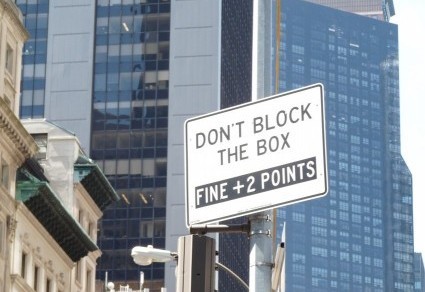
One more thought: The sign that accompanies each blog post (“Don’t Block the Box”) commands drivers to stay out of the intersection unless they’re sure they can drive through before the light changes. Yesterday, I did an informal survey. Cars blocked 9 out of 10 “boxes.” Pedestrians (including me) wove between vehicles, making what should be a straight path in a crosswalk into a curvy, almost choreographed, group dance. No one (including me) looked surprised or upset. Just another day in New York City.