Category Archives: Snarky Remarks on Grammar

Picky observations on grammar and writing style

Punc. Puzzles

What governs whether a sign-maker has room for letters and punctuation? Font? The size of the sign? I’m going for chaos theory, based on these signs. The first is from the “Dept of Transportation”:

Somehow “ped” got a period, but “dept” didn’t. Both are abbreviations, “ped” being the shortened form for “pedestrian” and “dept” for “department.” In case you’re wondering (actually, despite the fact that you’re not wondering at all), I should mention that this NYC “dept” isn’t consistent when it comes to punctuation relating to walkers:


Maybe the plural “peds” seems different to the dept? Grammatically, it’s not.

Not only “depts,” but also building owners get creative with punctuation:


Neither of the two sentences on this sign ends with a period. Also, “owners” should have an apostrophe, before the s or after it, depending upon how many people own the bikes. I gave up the apostrophe battle a long time ago, so I won’t dwell on that issue here. I do wonder (a) how the landlord can figure out who owns a bike and (b) exactly how the “expense” is collected. I’m betting this sign is an empty threat. (Also ineffective, given the number of bicycles that have nearly run me down on New York sidewalks. What’s the dept doing with the time saved by ignoring punctuation rules?) I also wonder about the criteria for capital letters in this sign. If standard rules for caps had been in effect, only “No” and “Removal” would qualify (first word of each sentence), as well as the “Ps” in the title, “Private Property.” If the caps were for emphasis, why is “expense” in lower case?

Another:

I understand that consistency is difficult to achieve in, say, a 200-page document. But if you’re working with only two sentences, you ought to be able to spare a period for each or omit the punctuation mark entirely.

Last but not least:

Okay, no period at the end of this sentence: I’m used to that. But I can’t find any reason for a comma before the conjunction “or.”  For that matter, I can’t find a reason for the text as written. Why not just say “DO NOT FEED BIRDS”? Theories welcome. Punc also.

Scratching an It

Pronouns create more problems per letter than any other part of speech, in my humble and completely unscientific opinion. You’d think that a scarcity of letters would open up fewer chances for error, but the opposite is true. Consider “it,” which is nearly as small as it gets, pun intended.

This sign is posted in a bathroom in a building owned and operated by a distinguished university, which shall remain nameless but not blameless:

I support the plea, the lavatory version of the Golden Rule, but not the pronoun. As the sentence is worded, “it” has to refer to “stalls and sinks.” Those items are clearly plural, and “it” is singular.

Now a few words from a distinguished newspaper, which shall also remain nameless:


When I first read this article, I thought that Loftsson’s whaling operation did not recognize “an international ban on commercial hunting.” Duh, I thought. They’re hunting; hence in the company’s view, the ban isn’t valid. A few minutes later, I realized that Iceland doesn’t recognize the ban. I probably would have caught on sooner had I had my morning coffee before reading the paper. But that’s why the rules for pronoun antecedents exist: to keep things clear even in the absence of caffeine.

Last is this caption, posted near the excavation of a Roman site. Mindful of my own frequent errors in the second and third languages I’ve studied, I’m ignoring the obvious translation issues. Instead, I’m focusing on the last word, “it”:

The photo is a bit unclear, so I reproduce the text here:

“Opening a settlement, to public visitors, would make some interventions destined for restoration, conservation, and spreading. The objective is to guarantee that the remains, mosaics, walls or paintings, wouldn’t deteriorate more than they are and, at the same time, visitors could understand them. Its appearance is never the same as the one in the excavation, neither is the one that had while the Hispanic-romans were using it.”

I dare you to define “it” with certainty. After reading other signs posted around the excavation, I realized that I was looking at the remains of a bath house and latrine. This “it,” in other words, has a lot in common with the modern restroom where I found the first sign. The more pronoun errors change, it seems, the more they stay the same.


Quick Questions

I’m not going to ask whether it’s “hot enough for you,” the standard query in NYC during August. In deference to the fact that everyone’s brains are fried, I’ll just post a few signs and ask a simple question about each. Feel free to answer.

On a sidewalk near Second Avenue:


Question: Do they think pedestrians will hurdle over the orange-and-white bars without this reminder?

In a shop on the West Side:


Does the flu vaccine advertised in the small circle to the left of the larger sign complement the lipstick or the powder?

From The New York Times:


Is “wildly unparalleled” a zig-zag or a right angle?

Finally, from a mini-golf course in Seattle:

Does this mean you should ignore the hand rails that are NOT provided?

Prize for the best answers is, well, nothing. But try anyway!

Service with a . . .

The rule used to be “service with a smile,” to which employees in stores and restaurants at least paid lip service. (Pun intended.) The rule has changed. Witness this sign, which my granddaughter spotted in a flower market:


I certainly sympathize with selfie-opponents, having been backed into, stepped on, and nearly blinded by people more interested in proving that they’d seen something than in actually seeing it. Think for a moment: the amazing place/thing/person that prompts people to take selfies is behind them. And unless, like countless generations of parents, you claim to have eyes in the back of your head, you aren’t seeing what you’re snapping. My sympathy for the flower seller doesn’t change the fact that her customers aren’t receiving any smiles here.

Or here, as noted by my friend Sharon:


Grammatically speaking, an introductory verb form (“To Better Serve You,” which by the way displays a strange set of capital letters) modifies the subject. In this sentence, the implied subject is “you,” as you are the one who is supposed to “Refrain From Cell Phone Use.” I’m not quarreling with the sentiment expressed by this sign. Everything I said about selfie-shooters applies to many cellphone-chatters also. But in the sign, grammatically, no one is serving “You.”  The sign really means “shut up and let me do my job and we’ll both be happier or at least not hate each other quite as much.” I think. The logic befuddles, but at least the sign writer was polite.

As was this one:


“Kindly”? Traditionally, that adverb was for the customer: “Kindly refrain from throwing paper money at the waiter,” or something like that. Here the restaurant believes that it is acting “kindly” by reminding you that you’re a dinosaur if you think you can pay with currency. I do like “cashless,” which, judging from the prices, isn’t going to be a problem for the owners unless their bank account is hacked.

I’ll end with refreshing honesty:


I prefer wine, but I think I’ll go to this restaurant anyway. Who can resist “mediocre service”?

Again with the Prepositions

The title of this post begins with an adverb and a preposition, in that order. For those who’ve never heard the expression “again with,” imagine those words spoken in exasperation, the same tone you’d use for “not again!” (eyeroll optional).  I hear “again with” often in New York City, but I don’t know whether it’s in common use in other areas. Custom, not set-in-stone grammar rules, generally governs prepositions. I wait “on line” in New York, but my granddaughter, who lives in Seattle, waits “in line.” Both of us are grammatically correct (and usually impatient).

Although you have a fair bit of leeway with prepositions, some usage is downright strange:


The odd texture of this photo comes from the screen in front of the sign. Every time I pass “these windows,” I wonder why a double preposition (“BY or NEAR”) appears. Either would make the same point. Coupled with the tripled exclamation point in the last line, I suspect the people living behind “these windows” aren’t happy with their ground-floor apartment. In NYC, that location means you’re essentially living in (on?) a crowded sidewalk, because screens and  glass do little to keep out smoke and between-puff conversation.

Another confusing preposition:


I hope the company’s food prep is better than its grammar, because “since” means the company was established at some point between 1983 and the present — including, say, this morning. A different preposition, “in,” would place the company in the “thirty years and counting” category, which I suspect is where it belongs.

Another:


I’m not sure why, but “repairs on” sounds odd to me. It makes me envision someone hovering above a necklace or a ring, loupe and screwdriver in hand. A helicopter jeweler, perhaps, for this era of helicopter parents? I’d substitute “to jewelry” or “repair of jewelry” or simply “jewelry repair.”

Last photo:

To be honest, I’m not sure what this sentence means, regardless of prepositions. I do know that “in points” should be “at points,” but the significance of “affected by” escapes me. Theories welcome AT any time, DURING any time period, FOR the foreseeable future.

Almost Perfect

Perfect isn’t possible, as we all know.  Almost perfect, on the other hand, is not only possible but common. But oh, sometimes that little gap between what you mean and what you write makes a huge difference. Here’s a bar with parenting problems:


“Mom” is my favorite day of the week. What’s yours? You can also see the first line of this sign as the beginning of a short-wave radio transmission: “Mom to Fri: I cooked all morning and you’d better show up for lunch!”  In that scenario, Fri is the son or daughter of someone with really poor naming skills.

Next is the announcement of a Supreme Court decision, sent to me by my son the attorney:


“Let’s” is the contraction of “let us.” The headline makes sense, sort of, if you insert a comma: “Court, let us states legalize sports betting.” The comma places “Court” in direct address, signifying that the states are pleading for legalized gambling. Which some were, as I understand.  I imagine that the headline writers were too busy canceling their bookie accounts to recognize that an apostrophe shouldn’t appear in that spot.

This sign was sent by a friend. I suspect the Tourist Board was rather upset to see that some important letters were missing:


To answer the question in line one: I did not know. Kansas City probably didn’t know either. Nor, I guess, did visitors. My advice: substitute “yearly.” It’s easy to make that word perfect.


Command Performance, Part 2

Bossing other people around is fun, isn’t it? Being bossed around, not so much. How many people do you think obey commands that appear on signs in NYC? Enough to sit comfortably on a beach towel, I imagine, based on what I generally see. Maybe that’s why this sign seems to sigh with resignation right before it screams:


Fine, “Management” implies, I know you may take a puff or bite or sip, but don’t even think about skating into my store. I hung out for a half hour without  glimpsing a single wheel. Nor did I see any cigarettes or snacks — just one water bottle peeking out from a handbag. Verdict: This sign is a rarity. It’s effective.

Not so these:


I could have snapped six more shots of signs prohibiting bicycles, each surrounded by bicycles locked to the railing, but you get the point. If any locks have been cut off and bicycles removed, new ones have sprung up in their place.

Some commands just beg to be disobeyed:


This sign makes me want to stay put. Alas, New York is always on the move, so that wasn’t an option. The next sign (courtesy of my friend Catherine) makes me want to move, quickly, to somewhere — anywhere — else:

Please explain what Fido is supposed to do if the curb is shut off. (At least the hyphen is right!) On second thought, please do not explain what Fido is supposed to do if the curb is shut off. I’d prefer not to know.

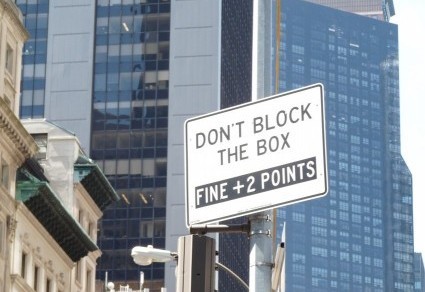
One more thought: The sign that accompanies each blog post (“Don’t Block the Box”) commands drivers to stay out of the intersection unless they’re sure they can drive through before the light changes. Yesterday, I did an informal survey. Cars blocked 9 out of 10 “boxes.” Pedestrians (including me) wove between vehicles, making what should be a straight path in a crosswalk into a curvy, almost choreographed, group dance. No one (including me) looked surprised or upset. Just another day in New York City.

PRE- Views

Three letters, three problems. Maybe more, if you estimate the number of misinterpretations possible with these signs, all of which contain the letters P, R, and E. Such as this one:

The prefix “pre-” means “before.” The office referred to in the sign above (a center providing services to senior citizens) closed . . . before its proper time?  forever, as in “permanently”? Perhaps both are true, and, I might add, tricky topics when you’re talking to or about old people, who may find distress in the concept of closing “premanently.” I passed one of the new locations of this organization yesterday, by the way. It’s at the bottom of a steep outdoor staircase, with no elevator in sight. They might be inviting a few premanent climbing injuries.

Onward and upward, to this ad, which appeared in today’s paper:


“Pre-owned” used to be the new “used,” but now, in a post-truth world, “pre-owned” is “new.”  (Digression: If this is the post-truth era, what was the pre-truth era like?)

I’m not wild about “pre-owned,” but to my mind it’s better than this expression:


“Pre-loved”? Seriously? I like my handbag. I use my handbag. I carry it everywhere. When I was little, the only expression I learned in Croatian, which my parents spoke when they wanted to hide something from me, was “watch your handbag,” so afraid were they that a passerby would snatch up my lunch money. But love? Nope. And if someone did “pre-love” a handbag, you have to wonder what shape the bag’s in. I think I’ll stick to “new” and “used,” premanently.

Can We Reach an Agreement?

Probably not, if you believe television pundits discussing the polarization of viewpoints on pretty much everything. Probably yes, if you ask me. I may be overly optimistic, but I still believe we can find our way back to respectful debate and at least some agreement on important issues.

But I’m not a politician, I’m a grammarian. In that context, my answer to the title question is “probably not.” Why? Take a look at these signs:

I snapped this photo on a bus, where the sign was attached to a curve. Hence the odd angle. In terms of agreement (the grammar rule that says singular pairs with singular and plural with plural), this sign also has an odd angle. The subject of the first sentence is plural (“a lot of funky smells”), but the verb, which is tucked into the contraction “there’s,” short for “there is,” is singular. No agreement there except among noses, which will indeed detect “a lot of funky smells’ with every sniff of New York air. Moving on to the second sentence: The subject and verb are both plural (“WashClubbers” and “are”). So far, so good. But “one”? I’m not sure what “WashClubbers” are, but I am sure they’re not “one.” They’re not grammarians, either. In case you’re curious, “one” is the subject complement in that sentence.

As they say on late-night TV, “Wait! There’s more!” 


I won’t go into the fact that the manufacturer thought customers needed to be told that “shower caps” are for people who want to keep their hair dry. (Okay, I’ll go into it a little: What else would you use a shower cap for? Fashion? Have you ever looked in the mirror when you’ve got one on your head?)  My focus is on the plural subject, “shower caps,” and the singular verb, “keeps.” Nope. Disagreement felony.

I’m not going to end with the platitudinous “let’s agree to disagree.” Instead, a call to arms: Let’s agree to agree, at least in grammar.

How to Speak Real Estate

In a previous post, “(Truly Real) Real Estate”  (http://www.grammarianinthecity.com/?p=783),  I went over the basics of how to speak the NYC dialect of Real Estate. I explain, for example, that “cozy” means small, and  a “charming” apartment hasn’t been renovated in fifty years.

For anyone moving on to the intermediate level — perhaps members of Gen X, Y, or Z looking for a spot in one of the city’s boroughs, here’s lesson two. Similar dwellings move up the price-ladder in this order:  “apartments” are cheaper than “residences,” which in turn cost less than “homes.” My personal favorite, “boutique,” is the most expensive. In the commercial market, the price of “an opportunity” is much more than what you shell out monthly to the landlord of a “store for rent.” Furthermore, assume that deadlines are open to interpretation:


I cut off the right side of the photo because I don’t like to give real phone numbers. I do like to give real dates, unlike the sign, which promises that the “residences” (price alert!) will be “Available Fall 2017.” I took the picture three days ago, in the spring of 2018. Judging from the scaffolding and debris scattered around, not to mention the “mandatory hard hat” sign, spring of 2019 is more likely.

And count on hyperbole. If a building is advertised as being “steps from Central Park,” the statement may be true only if you take about a thousand steps and have fairly long legs. (I actually saw this phrase on an ad for a building on my block, which is a brisk fifteen-minute walk from the park.)  Another hyperbole: a “home” (price alert again) advertised as on the 20th floor may actually be much lower. If you’re in an elevator on the way to an open house, notice whether the buttons skip, say, floors seven through nineteen. Then do the math.

But those are minor quibbles. Anyone can be late or exaggerate, right? Redefinition, on the other hand, is another matter entirely. Take a look at this ad:

For readers who have lived only in houses, I should explain that a “studio” is a one-room apartment. Except if it’s the studio advertised on this sign, which somehow has “2 room.” The hyphen, by the way, is missing in the compound adjective, “two-room” or, in this sign, “2-room.” (It’s probably hiding, too embarrassed to be part of this ad.)  The accompanying photo shows a large, bare room with no visible doors. Maybe they’re counting the bathroom as a room? Or they assume you can hang out in the basement with your bike, designating the storage area as a living room? Perhaps they believe you will pitch a tent in the “communal garden,” which, because we’re talking about New York City, could possibly have plants but may also be a patch of concrete without a roof.

Lesson for the NYC house hunter: learn to speak our real-estate dialect, and, as always, buyer beware.