Author Archives: Geraldine

About Geraldine

Forty years of teaching English, a lifetime of walking around New York City, and fifty or so books: my qualifications for making snarky comments on language as I see and hear it in New York.

What Are You Reading?

I was the kind of kid who fell down the stairs because I didn’t want to stop reading whatever book I’d just taken out of the library. Then I became an English teacher and a writer. So you’ll understand why my heart went pitter-patter when I saw this on a forklift outside a large food market in my neighborhood:

I pass this store often, so I can report with confidence that every forklift has a “literature packet” strapped to its vertical shaft. I’ve spent a lot of time speculating about the contents of the “literature packet,” wondering what genres are represented and whether the literature changes with the seasons. This being autumn, I’d choose Frost’s “After Apple-Picking”  or “This Is Just to Say” by William Carlos Williams, possibly the best poem ever written about food larceny. (It’s the one where the speaker confesses that he has “eaten the plums” that someone was “probably saving for breakfast.”)  Or maybe the packet contains the script of “Babette’s Feast” or the Christmas dinner scene from Great Expectations.  Yes, I know, the “literature” is probably operating instructions, but a grammarian can dream, can’t she?

Less appealing is this headline from The New York Times, the newspaper I read every day and which, in my opinion, should know better than to write this:

According to the dictionary, a “drove” is “a herd or flock” or “a large mass of people acting in unison.” Therefore, “Zimbabweans” can turn out in “droves,” but not “Zimbabwe.” Unless a mass of countries with that name  somehow didn’t make it onto the map?

Hanging by a thread onto the theme of this post (that you have to read the sign is my only justification, other than the fact that this one is too good to omit) is an ad for Crocs:


My friend Trent snapped this photo while on vacation. He said thought it might be for “those participating in hop-scotch tournaments” who need a spare Croc “in case of a “blow-out.” Excellent theory. As for me, I wonder whether someone taking advantage of this deal ends up with five shoes, as depicted in the sign, or five pairs. The first would be quite useful for those of us who have five feet — huge, untapped market there! — and the second for people who don’t feel their shoe supply is adequate unless they can cover every weekday with a different pair of Crocs. I’m not in either category, and I strongly suspect not many readers fit Trent’s theory either. If only this sign came with a literature packet! Then we’d know. If there are any “droves of Croc” reading this post, please feel free to enlighten us. In the meantime, happy reading.

I Give Up

After decades of bellyaching about the sad state of NYC signs, I have officially given up  — on some issues, not on all. Grammarian in the City will no longer object to the following:

As far as I’m concerned, BOGO all you want. I once thought that the concept of “buy one get one” was an unnecessary statement of the standard deal between buyer and seller. But now I see that most BOGO-users are too busy surfing social media to add an “F,” for “free.” Or maybe they think that BOGOF sounds like a mediocre brand of caviar. I commend this sign-writer for specifying the terms of the deal, spelling out “buy one get one” for “50% Off,” though strictly speaking the sign should read “BOGAOF50%O” (buy one get another one for 50% off). I concede that such a sign resembles the kind of password people concoct and promptly forget. I will, however, raise an objection to “tight.” I  prefer to cover both legs with “tights,” not just one with a “FREE tight.” And $75 is a little steep, don’t you think?

I’ve also thrown in the towel when it come to hyphens:

My first glimpse of this truck made we wonder whether Bunsen burners are prone to out-of-control blazes. If so, I thought, there is certainly a need for “scientific-fire prevention.” But perhaps this company pursues customers who prefer that the laws of physics take priority in battling flames? That meaning would call for “scientific fire-prevention.” Whatever. I’m done with fulminating about hyphenating.

Nor will I say one word about the silliness of this sort of sign:

Okay, just a couple of words: Is there anyone who believes that amateurs rent stores, buy equipment, and have signs painted so that they can repair “hand-bags,” zippers,” and “luggage”?  Judging from the trend to specify “professional” dry-cleaning, barbering, and other services, I guess the answer is yes. No matter. I don’t care. I can even live with this sign’s reference to moribund footwear (“dying” not “dyeing”).

Inaccurate acronyms, missing hyphens, and dead shoes:  This “professional” grammarian has given up on them all.

What’s Open?

When my son was little, we couldn’t walk down our block without having the baker rush over with a piece of bread, the dry cleaner offer candy, and the deli clerk donate a cookie. Toddler paradise! When I walk down that same street with my granddaughter, her experience is different. So many stores have closed! E-commerce and, I’ve read, some unwise rent laws have led to a surge in vacancies. What’s open, and when? These signs offer absolutely no help:

Given this timetable, I expect another empty storefront soon. Here’s another:

I’m happy about the “Grand Open”; at least the storefront isn’t vacant. I do wonder whether the $29 price includes both feet. I also wonder how long after the “grand open” I’ll see this sort of sign:

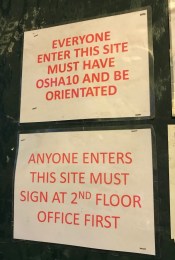
Near where the “out business” used to be is this sign, professionally printed and posted all over a building under construction:

According to the dictionary, “amenities” are “desirable or useful features of a building or a place.”  This sign is okay — grammatically, at least. Winding through scaffolding to play billiards or to sit near a communal wine cellar before your apartment is constructed is not okay, at least for me. But if you don’t care, go for it.

Although the word is correctly used in the last sign, I couldn’t help thinking about another definition of “amenities”: “social courtesies.” Sadly, everything I see in our public life shows me that this sort of “amenities” is absolutely NOT “now open.” If we can’t find our way back to civility, I fear that soon we will also be “out business,” and not just from 11 to 12 each day.

Unmentionables

This morning, for algorithmic reasons beyond my comprehension, a video of a woman squeezing herself into some sort of elastic tube appeared on my social-media feed. Her message, after the tube had turned into a tourniquet around her waist, was that this garment hurt. Well, duh. Call me old-fashioned, but there are a few things I’d rather not see. Or know, such as what this sign means:

I know it costs $4. I know that the number one and “Pcs” don’t match. I don’t want to know what an “ashtray glass bra” is, much less buy or wear one. In case you’re wondering, this sign was in front of a (strapless) jar.

Nor do I care to discuss this sign:

Is $12 the sale price? Or are the bras even cheaper, now that they’re on sale? Are they made of glass ashtrays? Forget I asked. I don’t want to know.

Moral of this post: The Victorians called underwear “unmentionables” for a reason. A good reason.

Tense Teaching

Labor Day has passed, and school has begun. Like autumn leaves, rants from nonteachers about what’s wrong with our schools/teachers/kids pop up, exasperating pretty much everybody who’s ever actually entered a classroom and tried to educate some kids. It seems like a good time to examine a photo my friend Catherine, a fine teacher, sent me:

Catherine spotted this in a doctor’s office, where the medical staff either believed that their patients already knew everything or saw the task of educating them as hopeless. Or, more likely, the docs were too busy filling out insurance forms to tuck some pamphlets into the container.

But there’s another way to interpret this sign. It labels “education” as “patient.” In my opinion, that’s what true education is and what teachers must be. Patient people know that change takes time. And time is tense  (not the physical and emotional state, though “tense” is what anyone would feel after spending the day with twenty squirming, wish-it-were-still-summer, small beings). In grammar, tense creates a time frame.  

Teachers work in three tenses. They must take into account what their students already know (past tense) and what the kids are doing now (present tense), be it wadding gum into the spout of the water fountain or solving long division problems. Invisible but most important is the work teachers do in and for the future. Good teachers don’t simply impart information. They cultivate critical thinking, healthy life habits, and an appreciation of others’ perspectives. They don’t see immediate results. But those seeds grow, slowly. In the future, what teachers planted — they can only hope! — matures and ripens.

I have one more sign for all nonteachers espousing unfounded and unfunded ideas about education:


Politicians and pundits: Go ahead and disturb all the classes that aren’t “in session.” Then take a moment to thank teachers for creating our future.

Grammarians in Other Cities

New York is generally the city  this grammarian is in, but not always.  On a recent trip to Washington, D.C., I found myself puzzled by more than politics:

This sign was in the window of a shop specializing in shipping and receiving packages. At first I thought the clerks were tired of inquiries about a service they did not provide, but the walls were lined with mail boxes. My next theory was that the sign would disappear when the mail showed up. Over the course of four days, though, the sign remained, even at night. My third and final thought — though I’m open to suggestions — is that this sign is an existential statement (“The mail is not here because it, like life, is an illusion”).

Before I returned to New York to retrieve my all-too-existent mail, mostly ads and bills, I walked around the capital. Tiring, I headed for the metro on 12th Street.  I was heartened by the fact that I was currently on 13th. Only one block to go, I thought. Wrong! Here’s what I saw at the next corner:

That’s it for Washington. Friendly grammarians in other cities sent me these gems. From Ellie in Montreal:

One can only hope that this fellow’s brick work is better than his spelling of “chimney.”

Here’s a contribution from Don in San Francisco:

I do hope that the “ethnic ingredients” have been cooked into some sort of meal, rather than presented as a set of separate, grocery-store packages. Ditto for the “can vegetables.” And while we’re on the subject of “can vegetables,” is that something the restaurant really wants to brag about?  Or is this some sort of “truth in labeling” requirement?  Given that both halves of the sign are labeled “lunch & dinner,” the offerings are strange. I guess you could enjoy them on a half-street, next to a fireplace with a clean chimniey, as you read no mail.

Punc. Puzzles

What governs whether a sign-maker has room for letters and punctuation? Font? The size of the sign? I’m going for chaos theory, based on these signs. The first is from the “Dept of Transportation”:

Somehow “ped” got a period, but “dept” didn’t. Both are abbreviations, “ped” being the shortened form for “pedestrian” and “dept” for “department.” In case you’re wondering (actually, despite the fact that you’re not wondering at all), I should mention that this NYC “dept” isn’t consistent when it comes to punctuation relating to walkers:


Maybe the plural “peds” seems different to the dept? Grammatically, it’s not.

Not only “depts,” but also building owners get creative with punctuation:


Neither of the two sentences on this sign ends with a period. Also, “owners” should have an apostrophe, before the s or after it, depending upon how many people own the bikes. I gave up the apostrophe battle a long time ago, so I won’t dwell on that issue here. I do wonder (a) how the landlord can figure out who owns a bike and (b) exactly how the “expense” is collected. I’m betting this sign is an empty threat. (Also ineffective, given the number of bicycles that have nearly run me down on New York sidewalks. What’s the dept doing with the time saved by ignoring punctuation rules?) I also wonder about the criteria for capital letters in this sign. If standard rules for caps had been in effect, only “No” and “Removal” would qualify (first word of each sentence), as well as the “Ps” in the title, “Private Property.” If the caps were for emphasis, why is “expense” in lower case?

Another:

I understand that consistency is difficult to achieve in, say, a 200-page document. But if you’re working with only two sentences, you ought to be able to spare a period for each or omit the punctuation mark entirely.

Last but not least:

Okay, no period at the end of this sentence: I’m used to that. But I can’t find any reason for a comma before the conjunction “or.”  For that matter, I can’t find a reason for the text as written. Why not just say “DO NOT FEED BIRDS”? Theories welcome. Punc also.

Scratching an It

Pronouns create more problems per letter than any other part of speech, in my humble and completely unscientific opinion. You’d think that a scarcity of letters would open up fewer chances for error, but the opposite is true. Consider “it,” which is nearly as small as it gets, pun intended.

This sign is posted in a bathroom in a building owned and operated by a distinguished university, which shall remain nameless but not blameless:

I support the plea, the lavatory version of the Golden Rule, but not the pronoun. As the sentence is worded, “it” has to refer to “stalls and sinks.” Those items are clearly plural, and “it” is singular.

Now a few words from a distinguished newspaper, which shall also remain nameless:


When I first read this article, I thought that Loftsson’s whaling operation did not recognize “an international ban on commercial hunting.” Duh, I thought. They’re hunting; hence in the company’s view, the ban isn’t valid. A few minutes later, I realized that Iceland doesn’t recognize the ban. I probably would have caught on sooner had I had my morning coffee before reading the paper. But that’s why the rules for pronoun antecedents exist: to keep things clear even in the absence of caffeine.

Last is this caption, posted near the excavation of a Roman site. Mindful of my own frequent errors in the second and third languages I’ve studied, I’m ignoring the obvious translation issues. Instead, I’m focusing on the last word, “it”:

The photo is a bit unclear, so I reproduce the text here:

“Opening a settlement, to public visitors, would make some interventions destined for restoration, conservation, and spreading. The objective is to guarantee that the remains, mosaics, walls or paintings, wouldn’t deteriorate more than they are and, at the same time, visitors could understand them. Its appearance is never the same as the one in the excavation, neither is the one that had while the Hispanic-romans were using it.”

I dare you to define “it” with certainty. After reading other signs posted around the excavation, I realized that I was looking at the remains of a bath house and latrine. This “it,” in other words, has a lot in common with the modern restroom where I found the first sign. The more pronoun errors change, it seems, the more they stay the same.


Quick Questions

I’m not going to ask whether it’s “hot enough for you,” the standard query in NYC during August. In deference to the fact that everyone’s brains are fried, I’ll just post a few signs and ask a simple question about each. Feel free to answer.

On a sidewalk near Second Avenue:


Question: Do they think pedestrians will hurdle over the orange-and-white bars without this reminder?

In a shop on the West Side:


Does the flu vaccine advertised in the small circle to the left of the larger sign complement the lipstick or the powder?

From The New York Times:


Is “wildly unparalleled” a zig-zag or a right angle?

Finally, from a mini-golf course in Seattle:

Does this mean you should ignore the hand rails that are NOT provided?

Prize for the best answers is, well, nothing. But try anyway!

Service with a . . .

The rule used to be “service with a smile,” to which employees in stores and restaurants at least paid lip service. (Pun intended.) The rule has changed. Witness this sign, which my granddaughter spotted in a flower market:


I certainly sympathize with selfie-opponents, having been backed into, stepped on, and nearly blinded by people more interested in proving that they’d seen something than in actually seeing it. Think for a moment: the amazing place/thing/person that prompts people to take selfies is behind them. And unless, like countless generations of parents, you claim to have eyes in the back of your head, you aren’t seeing what you’re snapping. My sympathy for the flower seller doesn’t change the fact that her customers aren’t receiving any smiles here.

Or here, as noted by my friend Sharon:


Grammatically speaking, an introductory verb form (“To Better Serve You,” which by the way displays a strange set of capital letters) modifies the subject. In this sentence, the implied subject is “you,” as you are the one who is supposed to “Refrain From Cell Phone Use.” I’m not quarreling with the sentiment expressed by this sign. Everything I said about selfie-shooters applies to many cellphone-chatters also. But in the sign, grammatically, no one is serving “You.”  The sign really means “shut up and let me do my job and we’ll both be happier or at least not hate each other quite as much.” I think. The logic befuddles, but at least the sign writer was polite.

As was this one:


“Kindly”? Traditionally, that adverb was for the customer: “Kindly refrain from throwing paper money at the waiter,” or something like that. Here the restaurant believes that it is acting “kindly” by reminding you that you’re a dinosaur if you think you can pay with currency. I do like “cashless,” which, judging from the prices, isn’t going to be a problem for the owners unless their bank account is hacked.

I’ll end with refreshing honesty:


I prefer wine, but I think I’ll go to this restaurant anyway. Who can resist “mediocre service”?