I don’t know whether everyone in Dublin has kissed the legendary Blarney Stone (“legendary” as in “imaginary or invented”), thereby picking up facility with language along with whatever microbes the previous kisser left behind. I do know that words seemed, to this tourist, more intriguing in Ireland than in many other spots I’ve visited, such as West 34th Street or Brooklyn Heights. Take this sign:

“Alouders” isn’t in the dictionary, but who cares? It’s easy to recognize “alouder” as “reciter.” Easy for everyone and everything except for autocorrect, that is, which keeps trying to change “alouder” to “alder.” I may never see “a poem as lovely as a tree,” to quote Joyce Kilmer, but I’d hate to trade the spoken word for a forest.
Then there’s this sign, cemented into an outer wall of the Museum of Decorative Arts, which is located in a former military installation called the Collins Barracks:

I have two theories about this sign. It may mark the location of a last-ditch line of defense. I mean, what else are you supposed to use if you run out of bullets and your saber’s edge is dull? Or it may be an art project, a cryptic reference to what can break bones. (I couldn’t find a similar panel labeled “Words That Can Never Hurt Me.”)
Perhaps my favorite Dublin sign is this one:

The school building has undoubtedly been modified since its founding more than four centuries ago. But St. Patrick’s Grammar School is still there, and still in session! Across the street in the Marsh Library (established in the 16th century also), a grammar book used by some of St. Patrick’s original students is on display.
That’s not blarney. That’s education.


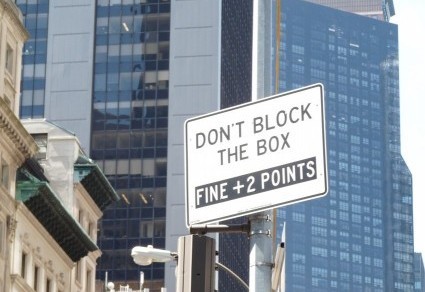
 Somehow “ped” got a period, but “dept” didn’t. Both are abbreviations, “ped” being the shortened form for “pedestrian” and “dept” for “department.” In case you’re wondering (actually, despite the fact that you’re not wondering at all), I should mention that this NYC “dept” isn’t consistent when it comes to punctuation relating to walkers:

 I understand that consistency is difficult to achieve in, say, a 200-page document. But if you’re working with only two sentences, you ought to be able to spare a period for each or omit the punctuation mark entirely.
 Okay, no period at the end of this sentence: I’m used to that. But I can’t find any reason for a comma before the conjunction “or.” For that matter, I can’t find a reason for the text as written. Why not just say “DO NOT FEED BIRDS”? Theories welcome. Punc also.


