Category Archives: Snotty Comments on NYC Signs

Mocking double meanings and pretentious language on street signs and ads

Unintended Meanings, Part 2

All business owners want to offer something unique. Their fondest wish is to drive out the competition by cornering a slice of the market that consumers can’t find elsewhere. Right?

Wrong, according to this sign, which I’m pretty sure doesn’t say what the proprietor intended:


"Everyday" is not "every day"

“Everyday” is not “every day”


The service in this salon is available “all day.” So far, so good. But to move from the 24 to the 7 part of the expression 24/7, the next words should be “every day,” not “everyday.” What’s the difference? The two-word expression means “today, tomorrow, the day after that, and so on.” The single-word expression means “ordinary” or “commonplace.” According to the sign,  you can get your hair styled in an ordinary way at an extraordinary time of day. (Even that statement isn’t totally accurate, as the salon isn’t in fact open all day. But that’s exaggeration, not grammar. I’ll let it go.)

A few blocks later, I saw this sign, which still confuses me. My first reaction was to wonder: What are “plumbing keys” and “electrical keys”? The gap in the middle suggests that the “keys made” part belongs to two columns.


What are "plumbing keys"?

What are “plumbing keys”?


Perhaps the owner wanted to emphasize this small but essential service to anyone needing an extra set of door keys? Or maybe the point was to capture my attention. If so, mission accomplished.

Lest you think that all I do is complain, here is a sign that (be still my beating heart), correctly pairs singular pronouns with a singular noun (pet):


His/her! Not "their"!

“Him/her,” not “them”!


In societies without companion-animal spas, designer cat beds, and dog booties, the pronoun “it” would suffice. But this is New York City in the 21st Century, which is rife with those items (and many more pet-indulgences).  Who am I to quibble with unconditional love and its pronoun necessities? I once had a parakeet that more or less lived on my shoulder, when she wasn’t laying eggs in my husband’s lap. (Note that I said she, not it.) So I’m giving this sign my seal of approval, not least because it begins with “please” and ends with “thank you,” two niceties that aren’t always found in the Big Apple.


Unintended Meanings

Walking around Manhattan, I often feel the urge to enter a store, grab an employee, and ask this question: “What, exactly, do you think your sign says?” I’m rather shy, and I also understand that most storeowners and employees are far more interested in selling goods and services than in grammar and usage. So I don’t ask anyone anything. Nor do I explain the unintended meaning of the signs I see, such as this one:

Just one bagel?

Just one bagel?


Get there early, people, because after one bagel is sold, you’re out of luck. Here’s another puzzler:

Three adjectives? Two adjectives and a noun?

Three adjectives? Two adjectives and a noun?


Does this sign offer the services of a gifted psychic or something else that is gifted, psychic, and spiritual? If so, what is that something else? Maybe the noun, psychic, is bookended by two descriptions – gifted and spiritual. I’d tell you the answer, but I can’t.  I’m not psychic.

And then there’s this salon, which offers a facial for the neck or back. If you’re working on those body parts, is it still a facial? Or are you getting a neckal and backal? But that’s not the best part of this sign. It’s the high frequency and excellent custom mask. I don’t know what that is, but I want one.


Custom mask?

Custom mask?


By the time I finished reading this sign, I had quite a few dead cells I wanted the shop to “eliminate” — from my brain.

Upcycling

Now trending, as they say in media far less long-winded than I am, is “upcycling” – taking discarded or undervalued material and pushing it up the value ladder. While I can appreciate the conversion of old rubber tires into sturdy sandals, I have some problems with upcycling language. Take a look at this sign, which turns a regular old cup of coffee into something else:

Small batch?

Small batch?


I guess “small-batch” is one of those terms you’re supposed to see as worth at least a dollar more per cup. After all, “small” implies that most people are excluded. The fact that this sign appears on a worldwide chain of coffee shops is irrelevant, though ironic. And speaking of “shops,” note the upcycling of this name:

Add two letters and double the price.

Add two letters and double the price.


Here’s another, for those of you who slap some polish on their fingertips (if that) and assume they’re ready for the runway:

Design team?

Design team?


Pause for a moment to  pity the team-less. To console themselves, they can go to a bar. Or, as the next sign indicates, they can visit a “taproom” where they have “craft beer” and, if I’m being grammatically picky (and I always am), a “craft kitchen,” whatever that means. Nowadays, “craft beer” frequently carries about as much meaning as “small batch,” given that conglomerates have taken over many of what used to local beer companies that really did make small batches.

P1010457


Not to belabor the point, which is already on overtime, here’s a sign that eschews (1) patriotism or (2) common sense by advocating “European Wax,” which is either a style of hair removal or a sticky product of bees residing abroad:


What's wrong with American wax?

What’s wrong with American wax?


I think I’ll stay home, make a small batch of coffee, and drink it in my craft kitchen. You’re welcome to join me.


Didn’t we win that war?

It’s been a long time since I studied American history, but until recently I was under the impression that we’d won the Revolutionary War. If we did, the Upper East Side apparently hasn’t gotten the message. Check out this sign from one of the local luxury food stores (yes, in this part of town there are several), which shall remain nameless to protect the pretentious:

Bespoke? Really?

Bespoke? Really?


I’m not going to touch the “dissappoint,” misspelled words being beneath my notice (usually), but it is a nice touch. This sign first appeared as a simple sheet of paper, printed by someone who hadn’t worried about the wavy red spellcheck line under what should read “disappoint.” About a week ago the store had the sign framed and mounted under a container of melon cubes. The busy employees don’t have time to read the sign aloud, so I can’t make a joke about someone who “misspoke” about “bespoke.” Sigh. What I can do is compare “bespoke fruit baskets” to “custom-made” or “made-to-order” fruit selections. What’s the difference? About thirty bucks, give or take. It’s the British influence.  Associate a word with Colin Firth’s accent, and the price goes up.

The same principle is at work with “Stonehenge Realty,” a name I see on any number of NYC buildings. I would keep the name to myself, for the same reason I’m reserving identification of the foolish fruit-seller, but in this case the name itself is the point. Now don’t get me wrong. I have visited Stonehenge (the real thing, not the apartment buildings), and I’ve marveled at its power and history. But in New York? Can’t you just picture a real estate agent, Armani on and portfolio ready, extolling the virtues of living under a rock slab? “You’ll love the workmanship on this monolith,” the agent in my fantasy says, “and rocks are practically maintenance free. Of course, in December and June the Druids have access, but they add character, don’t you agree?”

Don’t think the tendency to turn to Britain for luxury references is purely a matter of money, with whoever names apartment buildings (and who does, do you know?) applying the names of economic powerhouses to their houses. If so, I’d expect to see the “Beijing” or possibly the “Riyadh.” If they’re out there, I can’t locate them. Nor is it a former colony’s desire to show reverence to the mother country. If it were, someone would be living in the “Chiapas,” because we beat Mexico in a war also. Okay, technically it was Spain, but don’t quibble.

No, it’s cultural bias, plain and simple, the same impulse that drives the ratings for Downton Abbey into the stratosphere. The Yanks won the war, but the British won the peace.

That’s it for today. I’m off to high tea.

Can’t we all just calm down?

In the spirit of “colossal olives,” which is marketing-speak for “large,” I’m seeing language moving up on the intensity meter. Nothing seems to be “good” anymore. Good is the new so-so, and fair is foul these days, as it was in Macbeth. I give my order to a waiter, who replies, “Awesome!” Somehow, the tuna-on-rye, though tasty, does not move me to awe. A simple “good choice” works just fine.

I was thinking about this intensification trend when I saw these signs. Here’s one demonstrating way too much enthusiasm:

Special isn't enough. They're going for "special!!!"

Special isn’t enough. They’re going for “special!!!”


If the masseuse feels that much passion, I doubt I want the service offered. The masseuse may be, well, a practitioner in another business entirely. On the other hand, the sign writer, not the masseuse, may be the overly enthusiastic one. After all, Massage Special!!! was on the same street as this awning:

Note the name of this deli.

Note the name of this deli.


I wonder who owns this deli? The artist once “formerly” and then again known as Prince? I also wonder how  employees answer the phone. “Hello, this is !!!!!”? How exactly do you pronounce five exclamation points?

Or six?

exclamation points


Time to calm, down, people. Or perhaps I should say, in the spirit of the age, “Time to calm down, people!!!!!!!”

Hallucinations for sale

I’ve been “collecting” signs for a while. This post is a mix of old and new sightings in the category labeled “Huh?” that I add to nearly every day.  First up is a store that specializes in hallucinations. Does the DEA know?

Top quality visions only.

Top quality visions only.


Next is something my friend Michael sent me, with the email subject line “Word Crime.” Isn’t it wonderful to hydrate yourself for your entire lifetime for only $1.95? Quite a bargain.

free water


Below is another puzzle. We buy cash in exchange for cash?  And then there are the “old boyfriends.” (Young boyfriends, I guess, don’t count.)  Also, even if you insert an apostrophe and exchange your “old boyfriend’s jewelry” (singular) or “old boyfriends’ jewelry” (plural), aren’t you stealing the old guy’s jewelry? In the face of larceny, I won’t mention the missing comma after “gold” or the period that should follow “diamonds.” Should I be surprised that the store went out of business?

Turn your cash into cash? Not to mention your old boyfriends.

Turn your cash into cash? Not to mention your old boyfriends.


Unwinding 5000 Games

In the “what on earth does that mean?” category, here is the latest batch of signs  to stop me in my tracks. Once more I admit (maybe submit?) to the title “Grumpy Grammarian,” but really, what are these people trying to say?

First up is a poster in the window of a small copy shop in midtown:

Window tint print here?

Window tint print here?


After three or four visits to this block (no, I’m not that obsessive about signs, but one of my favorite bars is nearby), I finally decided that window tint print is the sort of film that sits on a window and lets some light through — enough light so that whoever buys it can claim that it doesn’t detract from the experience of, for example, a tourist peering through a shrink-wrapped  bus.  I guess imagination applies to the message on the window tint, and protection is the window tint itself. And what’s with the new? Was the old window tint inferior? Nonexistent? Feel free to come up with your own interpretation. Stop by the shop to see whether you’ve guessed correctly. (Then hit the bar across the street. It serves good beer.)

Next up is this neon sign, glowing prettily and selling — well, I don’t know what this store is selling. Does anyone know what “computer color graphic out put” is?

Out. Put.

Out. Put.


If you’re going to invest in neon signage, it might be a good idea to check your message. What are you putting and where, exactly, is out? Maybe they mean that you upload a color image (a graphic) and then it’s printed? Or beamed directly to the intended viewers’ eyeballs? (Targeted marketing, you know, is trending.)

The next sign has the advantage of being crystal clear, if somewhat unwelcoming. Not for New Yorkers those syrupy signs saying “I heart you” or “NYC hearts all those annoying tourists who bump into us natives on the sidewalk or hesitate two nanoseconds on the coffee shop line.” This one displays New York snark, my favorite tone:


New York does not  "heart" you.

New York does not
“heart” you.


One last sign. I don’t mind being commanded to play. I’m totally fine with the order to dine. But how do you unwind games? And not to be picky (okay, to be super-picky), the sign should read “more than” 5000 games, not “over.” (More than or fewer than is the expression you want for things you can count. Over and under work for quantities you measure.)

unwind


I’m “minutes away” from giving up on properly written signs. Join me there whenever you like.

For want of a hyphen, the meaning was lost

Hyphens sometimes seem like relics from the Age of Typewriters, when you had to hit a metal lever to roll the paper to a new line when you reached the right-hand margin, even if you were in the middle of a word. The hyphen told your reader that you weren’t finished yet and that the rest of the word was on the way. (Why do I feel I should explain iceboxes and record players next?) Word-processing programs move the whole word automatically when a margin is about to be breached, so hyphens have lost importance. They’re still around, though, creating compound words. Or at least, that’s what they’re supposed to do. Take a look:

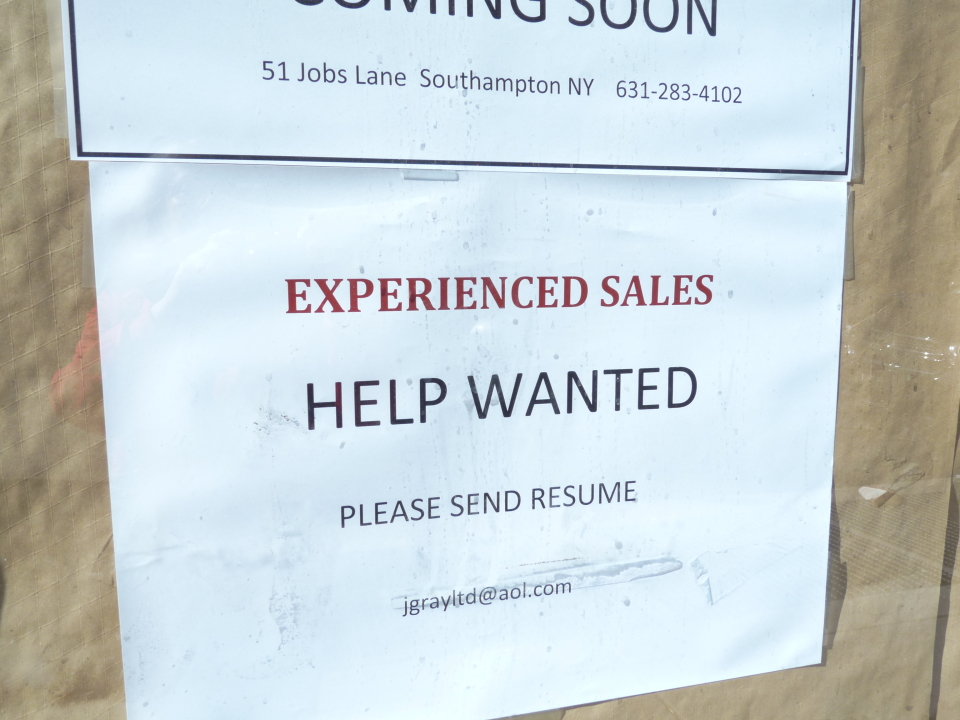
Experienced sales? Sales-help?

Experienced sales? Sales-help?


I caught sight of this sign while I was walking on First Avenue. I doubled back to figure out what “experienced sales” were. Sales that had seen a lot of life and now had a world-weary, been-there-done-that attitude? Sales that know the lady holding a bagel, venti soy latte, and cell phone is automatically bad news? Or was “sales” meant to be read all by itself as a new, nonsexist term for the older terms “salesman” and “saleslady”? A hyphen between sales and help would link those words and clarify the meaning.

All is not lost on the hyphen front, however. Here’s one that works:


One-stop as a single description! Grammarian of the Year Aware to the NYC Information Agency!

One-stop as a single description! Grammarian of the Year Award to the NYC Information Center!


Shout-out to the NYC agency that made one description out of two words, one and stop. Shouts (actually yells) to the laundry that mangled this sign:


Laundry machine? Machine press?

Laundry machine? Machine press?


What’s a laundry machine? Or a hand press? Yes, I know I’m grumpy grammarian again, because I did eventually figure out that machine press is the opposite of hand press. I’m still not over skirt plested in the top right column, but as soon as it stops raining, I plan to run out to buy two politically correct pajams.

To exit on a high note, here’s a truck with three (count ’em) correct hyphens, which create two compound adjectives:

do-it-yourself


If you’re relocating to New-York (the older form of this city’s name), consider this company. They may ruin your furniture (or you may do that yourself), but you’ll have the satisfaction of knowing that the hyphens on the truck are in the proper spots.


Missing and presumed . . .

Adding to the pretension stalking New York menus, my favorite bar has taken to posting prices like 3.5 and 1.5 after a detailed description of its artisanal pretzels and available toppings. I can only assume that the printer – actually a photocopier – charges by the character, so the missing zeroes are a sign of thrift, not a way to show you that this is not any ordinary bar, but one with originality (and expensive side snacks). Which would be true if 2.5 dollars’ worth of potato chips were not part of a larger pattern of missing letters and numbers. This sign, for example, kept me scratching my head for a few minutes:

N = ?

N = ?


N? Seriously? I objected (and actually still object) to shortening “and” to ‘n, which is a glorified grunt, but without the apostrophe all you’ve got is a letter. Also, what does “now” mean in this context? Were they going to place polish later? Earlier?

But back to the missing. Take a look at this sign:

Apostrophes AWOL as usual

Apostrophes AWOL as usual


Apostrophes are so often misused that finding mistakes with them is like shooting fish in a barrel. (Does anyone do that, by the way? Besides being unfair to fish, wouldn’t the barrel leak with a bullet hole in it?) Here the sign should read “men’s” and, ideally, “women’s and men’s.” I’m pretty sure of that fact, but I have no idea how “weaving” can be gendered. But then again, I know grammar, not fishing, shooting, or weaving.

This gem adds instead of subtracts. Focus on the hyphen:


A bar-deli?

A bar-deli?


I still can’t imagine what a bar-deli is, unless it’s a spot to knock back a beer while your salami is sliced and your macaroni salad weighed. And what’s with “produce”? Your guess is as good as mine, but I’m guessing that you can’t find anything cheaper than $5.5 at this Upper East Side bar-deli.

Don’t Sit the Birds

Grammar rules may seem irrelevant, but they do provide a frame of reference, standardizing meaning and enabling your audience to figure out what you’re trying to say. In this post, adapted from a page I created a while ago, I offer some signs that left me scratching my head. First up is this gem:

sit birds


This sign appeared above a two-inch-wide ledge outside a grocery store. I understand that you’re not supposed to feed the birds, but I guess you’re also not supposed to bend their little legs to make them sit on the ledge? (Yes, I know the sign-writer probably aimed this request at human beings. But trust me: No human rear could ever perch on this tiny spot.) The meaning, as written, is not clear, but at least the sign-writer was polite enough to say “please.”

Here’s another interesting sign:

What's an "overweight permit"?

What’s an “overweight permit”?


No doubt this sign is crystal clear to truck drivers. The rest of us are left in the dark, which is exactly where I do not want drivers to be as they navigate Park Avenue, one of the busier NYC roads. I want their attention on the road, thinking about pedestrians and other motorists. I don’t want them to wonder whether (a) it’s okay to drive with an overweight truck if you didn’t bother to get a permit or (b) a driver who is a little too fond of 2000-calorie lunches has to get an “overweight permit.”

How long are your feet? How wide are your shoulders? Measure them and then see whether you qualify for the “Package Special” advertised in this sign:


Ten inches?

Ten inches?


Items 3 and 4 use a single quotation mark, the traditional symbol for “inches.” The owner of this store may be using the navigational symbol for minutes, which pops up in measures of latitude and longitude. (Maybe the masseuse is a former sea captain?)

One more:

Neighborhood sensation


Are they offering “sensation”? Or welcoming it? And has the Vice Squad visited?