Category Archives: Snotty Comments on NYC Signs

Mocking double meanings and pretentious language on street signs and ads

They Should Know Better

When I read hand-lettered signs in small stores, I readily accept a certain number of mistakes from proprietors who, I presume, are too busy to proofread because they have to order stock, supervise employees, and fill out tax forms. But when major companies are involved, my expectations rise. Obviously I’m courting disappointment, because Those Who Should Know Better often don’t. Witness this advertisement from a nationwide cosmetics chain:

As a verb, “gift” strikes me as a bit pretentious, but it’s not incorrect. The direct object, though, is another issue entirely. The sign urges you to “gift” people. Human trafficking, anyone? Please say no, even if you have a few relatives you wouldn’t mind “gifting” to someone willing to take them far, far away from your holiday gatherings.

And then there’s the phone company. I won’t tell you which one; I imagine it’s easy to find horror stories about all of them. I had to visit and call the one responsible for this ad no fewer than eight times before I succeeded in canceling my late husband’s phone contract. Check out this recruitment pitch:


If they can’t come up with the proper contraction (“you’re,” not “your”), how can they “practice data story-telling, analytics, and more”? And while I’m on the subject, do we actually want “data story-telling”? Can’t we manage with “data” alone, leaving “story-telling” to fiction writers?

I count on good grammar when I read my favorite newspaper, The New York Times, and usually that’s what I get. Every once in a while, though, the editors miss something. Perhaps the excitement surrounding Amazon’s search for new office space overpowered this writer:


I wouldn’t mind “500,000 square foot modern of office space,” if I could figure out what it is.

One more, from a chain restaurant:


I’ve always wanted to try the wings at this restaurant, but I’ll pass on the “sloo smoked BBQ.” I’ve never liked the taste of “sloo.”

Bus Woes

Aren’t buses annoying? First of all, there’s that plural. The usual phonetic rules call for a double “s” in the plural, and some people do indeed write “busses.” “Buses” is more common, yet for some reason I feel slightly wrong every time I write it. Then there’s the actual bus, which never comes on time because it’s waiting for a quorum. Passengers, that’s the real reason you see four buses pull up at the same time. Unless there’s a group of four, the bus-run can’t begin. Finally, there are the silly signs both inside and outside of the vehicles. For example:


It’s worth noting that NYC city buses (except those on the airport route) don’t have luggage racks. But even if they did, are there people who need to be reminded not to climb the walls and sling a leg over a metal bar? Actually, scratch that question. This is NYC, so the answer is probably yes. I do wonder why “Luggage Rack” is capitalized. Normally, generic nouns are written in lower case. Perhaps adding capital letters makes the nonexistent item more real.

Moving on:

This one was on a tourist bus, so warning people not to slide the roof or throw packages is probably a good idea. People’s brains tend to hibernate when they’re on vacation. My favorite part of this sign is “frequencies.” I’d expect a singular there, because the time period between events varies, not the time periods. “Frequencies” makes me think of radio stations and, vaguely, astrophysics, which I can think about only vaguely because I have no actual knowledge of the subject. Also, why “approximately”? Isn’t that implied by “vary from 8 to 15 minutes”?

I used this photo in another post (http://www.grammarianinthecity.com/?p=2159) but I can’t resist repeating it because it’s such a good example of the “bizarre bus sign” genre:


DNA. Good to know. If you want to maintain your privacy, try not to shed any cells while riding. And if you wish to explore your genetic heritage, this bus is for you. Happy riding.

Planes, But No Trains or Automobiles

I’ve spent way too much time in airports lately, but my time loss is Grammarian-in-the-City’s gain, because those hours yielded some interesting material for this blog.

First up is a sign in JFK Airport that I stared at for what seemed like hours (because it actually was hours — the plane was late):

Good advice. I hate collaborating alone.

Moving on, I saw this advertisement in Madrid’s Barajas Airport:


I’m not sure what a “deli flight” is, but I’m certain that I didn’t have one. I’m pretty sure I don’t want one, either.

Speaking of Barajas, the map of stores and other amenities in Terminal 4 included this item:

The number 15 corresponds to a spot on the map (I think), so that’s one mystery solved. I never did find the “Hour Passion” store to see what it was selling. I’m not sure I want to know.

My ideal airport would let me get in, get on, and get out as quickly as possible. Too bad that ideal never becomes remotely real. If you’re flying during the holidays, good luck!  Feel free to send me any interesting signs you encounter.

Practice What You Pre-ach

The prefix pre- is a useful little syllable that means “before” — a fact that makes this sign, which appeared on the window of a new store, particularly confusing:


I’m assuming that “Pre Open” means the store hasn’t had an official grand opening with flags, pop-ups on social media, and token gifts for customers. “Liquidation” is what stores do when they turn all their assets into cash prior to going out of business. So this sign means that the store is (a) not yet open and (b) preparing to close forever. If you want to buy anything here, you have to jump right on the line between existence and nonexistence.

Here’s another mangled  pre- sign:


Huh? This sales pitch is the equivalent of “Hurry in! Today’s $50 trinket will be $25 tomorrow! Take advantage of our “pre sale” and lose money!” Who could resist that offer?

Taking a break from writing this post, I checked Facebook, which told me that this blog had drawn “ten new previews” since the last time I looked. I know from the weekly stats Facebook sends me that Grammarian in the City gets twice as many “previews” as views. What I don’t know is the Facebook definition of preview. Someone takes a quick look and decides nope, not for me? But isn’t that a view? Anyone out there who knows, please share the knowledge.

All this talk about pre- makes me ponder post-, a prefix meaning “after.” When it’s not in that role, post shows up as a noun meaning “letters that come in the mail,” “a job,” or “an upright building support,” among other definitions. The derivations are different, but it’s tempting to think those words arose from the assumption that mail is always late, as are workers and contractors. Not to mention bloggers, whose posts appear several days after their intended publication date. Yes, I’m in that tardy group, as I’d planned to publish this post last Wednesday. My pre-New Year’s resolution is not to postpone posts. Preview this page frequently to see whether I keep my resolution.

Traffic Favorites

During the holiday season “clip shows” pop up, presumably to give those involved in creating them some time with their families. Grammarian in the City is no different. I’ve just returned from vacation, where I occasionally snapped photos of ridiculous signs for use in future posts. While working through jet lag, I’m recombining bits of old posts of some of my favorite traffic signs, such as . . .


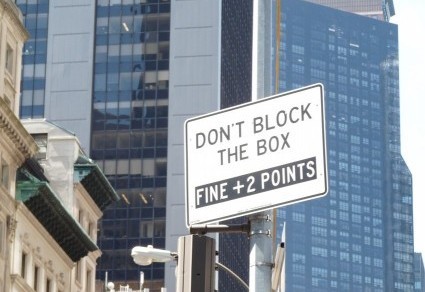
The word “oxymoron” was invented for situations like this one — especially the last two syllables, which are reserved for the sign-posters, who want you to stop and not stop at the same intersection — which, by the way, is in front of the United Nations, where contradictory statements occur with some regularity.

And then there’s . . .

If you’re a truck needing Weight Watchers, you can drive on this street as long as you don’t get an “overweight permit,” which I presume is some sort of legal document. Thus this sign tells you to break the law or stay off Park Avenue.

And for those of you who drive taxis . . .

From this sign I assume that taxis with more than one passenger can go anywhere, but if your destination is above “46 St” or you have a crowd in the back seat, you’re out of luck.

Holiday Shopping

Judging by the signs I’ve spotted recently, merchants are hoping you’ll purchase fashionable holiday attire — for your furniture. An example:

Surely you weren’t planning on ushering guests into a room with a naked table! A four-legged pair of jeans would do nicely for a hip, can’t-be-bothered-to-dress-up dinette set. An evening gown with a very wide skirt saves formal hosts from the embarrassment of an underdressed eating surface. No hint from the shopkeeper about what sort of “table clothes” are available. If the customer isn’t pleased with the styles on sale, “sheets” could possibly preserve the table’s modesty.

Sheets, by the way, seem to tangle when they encounter signs, much as they do in a washing machine:

My bed has lumps, but no bedbugs or a single  “pillow sheet.” How about yours? Maybe a “pillow sheet” would be a good gift.

Still in the linen closet, I’ll move on to the next sign, trying not to cry that the apostrophe rule has crashed and burned once again:


The apostrophe give a sheet possession of the “sale,” which, judging by the price but not the quality of the merchandise, is a pretty good deal. Why is it that so many people persist in thinking that an apostrophe creates a plural? Theories welcome.

I’m obviously stressed about punctuation, and this sign didn’t help:

The bullet point in front of “house” was odd because there were no other items on the sign, hence no bulleted list. But if I’m opting to tinker with punctuation, I’m going for a comma after “house.” That comma would create a direct address statement appropriate to this holiday season:  “House, hold items [so I don’t have to].” See? Shopping-stress relief!

Enough grammar quibbles. Focus on what’s important about Thanksgiving and other holidays:


Do what the sign says: “Enjoy you holiday.”

The Next Logical Question

A challenge of writing is to distinguish between what’s in the mind and what’s on the page, or, in the case of this blog post, on the sign. No doubt these sign writers thought they were expressing themselves perfectly, but each left me with at least one unanswered question. For example:


Unanswered Question: What do the “gas leaks” say?

I should note that a little punctuation would have gone a long way. A question mark after “leaks” and a period or exclamation point after “us” would do nicely here. On the other hand, clarity may be overrated. I did spend an enjoyable quarter hour thinking up possible dialogue:

COMPANY: Good morning. How may I help you?

GAS LEAK: Hiss …sss … sss.

Longer but not clearer is this one:


Unanswered Questions: Why do “pearls” (plural) outnumber “diamond” (singular)? And does the shop really grind up precious gems? Most important: Does anyone working in this shop actually know what these facials are?

Once again I’m struck by the number of nonsense words employed by the “beauty” industry. I read a Sunday NY Times feature on skin and hair care for several weeks before I realized that it was not, in fact, a parody. Moving on:


Unanswered Questions: How many passengers need a DNA Kit? Can’t they check their genetic heritage at home? Does the transit authority seriously believe that a robber will stand still long enough for a cheek swab?

The difference between “may be” and “is” seems significant, but I can’t quite figure out why. My best guess is that the MTA wants you to know that they are not necessarily watching but they are always ready to roll when it comes to your genes. Last one:

Unanswered Question: What happened to the candlestick maker?

I did toy with the idea that the “butcher” chops up a “prime” number — not into factors, but maybe into pieces, like severing the top circle of an eight from the bottom. That interpretation leaves out the “baker,” who may bake less than prime quality bread and cake. Perhaps that’s why the candlestick maker quit.

Sspeling Erorrs

I don’t usually bother with spelling mistakes, but when they appear on expensively produced ads, it seems to me that someone should have proofread before printing. Or before handing the finished product over to the customer. Or, at the very least, before hanging the sign on a store window, truck, or sandwich board.

Whether to double a letter or not seems to attract (atract?) errors like iron filings to a magnet (fillings to a magnett?):


Does this shop offer feline treats (mice, catnip, permission to snooze on a sofa that’s usually off-limits)? Or does the store host gossip fests, where guests can be as catty as they please?

Maybe the shop that does “cattering” should lend one of its Ts to this food cart:


I leave aside the issue of eating lunch at 10 AM or 4 PM, given that New York is the city that never sleeps and meals roam around the clock dial like sleepwalkers in a kitchen. Nor will I focus on the random capital letters, though I can’t help wondering whether lunch Time is supposed to reflect the eternal nature and importance of Time or whether the expression refers to a magazine. Instead I’ll confine myself to the meaning of the first line. Is the food cart offering to have the employee in charge of placing rice on the plate accompany you while you eat? And is Free Can Soda a call to action? I do like that sm matches content to form. The abbreviation sm is indeed small.

I don’t want you to think that whether to double the letter T is the only problem out there. S comes with stress in these signs:


Had I a marker and not an aversion to graffiti, I’d remove the extra S from “tresspassingin the second sign and add it to kind in the first. While wondering whether the second sign banned a hair-exchange app, I’d also delete the extra f from proffessional  or get rid of the word entirely. I mean, who else works in a tailor shop? Amateurs? Hobbyists? Not for those prices they don’t.

Now if only these stores would shell out a little cash for some proffessionnall prooffrreadding.

Dumb Questions

One day when I was teaching ninth-grade English, a student approached me during a test. “When it says ‘answer the question’ should I answer the question?” I mention this incident, which sits in my memory bank right next to the time a senior wanted to know whether the government had a “suppository of documents” nearby, because I ask some pretty dumb questions, too. Such as . . .


Doesn’t number two on this list — “imported & domestic items” —  include everything ? If so, why not just say “everything”? And does the customer have to choose: “I want domestic items only, please” or “If it’s not from here, I’m buying it”?

More dumb questions:

“Your portrait painting here”?


Does “your portrait painting here” mean that you and Abe are in it together? Does he stay the same size while you’re squeezed into the upper left corner? Why write “portrait” and “painting”? Isn’t that overkill, like the “oral mouth care” ad I heard on the radio recently?

Dumb Question #3:

Is the price “around 50 cent”? Why not give an exact price? And why not “cents”? Is a rapper in the vicinity? I won’t ask who’d buy wings “all day and night” because this is the city that never sleeps, and that sort of schedule leads to interesting dietary habits and, possibly, the omission of crucial punctuation.

Last one:

Do you call the front desk for “boom service,” and if so, how much do you tip the guy who lowers the boom?  How do you delivery a “jobsite”? And what does a “boom service” showroom show?

Inquiring minds want to know.

.9 Children

No, the title is not a typo. The US Census reports that the average American family has .9 children. When you remove childless families from the calculation, the average number jumps to 1.86. I know at least some math, so I’m not questioning the silliness of .9 or 1.86 kids. Statistics and real life don’t always mesh well, though I do wonder what a .9 kid would look like.

I am questioning absurd signs, such as this poster advertising acting classes:


“Classes for 0 – 18 years.” How, exactly, do you teach a zero-year-old? Have the mother give birth on stage? I thought I was in favor of arts education for all, but now I realize that I’m in favor of arts classes for most. I draw the line a teensy bit higher than zero years.

Another interpretation of this sign revolves around how long the classes run. If you’ve been in class for 18 years, I assume you have an Oscar, Emmy, Tony, and every other performing arts trophy. I also hope that somewhere during those 18 years, you had a coffee break and a restroom excursion or two. The question arises: Who would sign up for a class that meets for O years? Probably someone who wants to say “I studied acting” but doesn’t want to go to class. In my teaching career, I met a fair number of kids in that category.

The next population statement is from a clothing store:


One wonders if this is a sociological statement. One also wonders why the adults are singular (“Man,” even though there are 2, and “Woman”). For the sake of parallelism, the English-teacher term for balance and uniformity in a list, shouldn’t it be “Kid”?

Same store, different aisle:


The parallelism problem is still present, but the numbers make more sense. If the average family has .9 children, the “-1” could work, unless you’re addressing the average number of children in families that actually have them (the most likely buyers of kids’ clothing), in which case the sign-writers should reference the 1.86 average and maybe go with “1+” or “I-ish.”

I’m not going to analyze the “2 Man, 1 Woman” issue presented in both signs. Seriously, I’m not even going to mention it. But I will show you this sign:

Aside from parallelism — you shop for gear for “kids” (plural) and “baby” (singular) — it’s a relief to know that the kids and baby are inside, not in the middle of Third Avenue’s perpetual traffic jam.

I’m off to look at photos of my two (a whole and completely logical number, I must point out) granddaughters. Have fun with your .9 (or 1.86 or however many) kids. Or just enjoy this autumn day.