Category Archives: Snarky Remarks on Grammar

Picky observations on grammar and writing style

Fatal Messages

I was strolling through the East Village and Chelsea recently, two areas of Manhattan with a fairly high hipness score. (I can tell you right now that, not having any tattoos, I felt like an enemy agent, or at best an emissary from the Country of Old People.) I noticed these signs, which I hope were aiming for humor and not accurately reporting services offered. But these days, who knows? First up:

Do the police know?

Do the police know?


I wondered whether the shop operated a guillotine or something less fatal. (Repeat business, after all, doesn’t flourish if the head is in a basket and the body in a chair.) Seeing no rivulets of blood seeping under the door, I kept reading:

Apostrophes would be nice.

Please tell me we’re talking about hair.


Where do I start? “Mens” needs an apostrophe, and “women” needs both an apostrophe and the letter S. Given the guillotine reference, I wouldn’t mind seeing “hair” before the word “cuts.” But in a neighborhood where anyone who doesn’t display a pierced something is an anomaly, maybe the sign should say “men and women cut,” to inform the public that the slicing and dicing on sale is gender-neutral.

The next time I need a cut – and I do refer to hair – I may stop by. I’ll let you know the result, if I’m still alive.

Stock up now!

Want to talk about today’s storm? That might be difficult. Wordsmiths are woefully unprepared for the hyperbole-shortage caused by Jonas. (By the way, since when do non-hurricanes get names?) A completely unscientific survey showed that New Yorkers heeded warnings about emergency preparedness – for some things. In my local grocery store, for example, one woman at the checkout bought maybe three dozen individual-serving pudding containers. If Jonas decimates the nation’s sugar supply, she’s ready.

The real shortage, I’ve concluded after listening to the radio, watching television, and reading news reports, is hyperbole. If you want an extreme term for today’s weather, dictionary shelves are nearly bare. Stocks of “snowmageddon” were the first to be depleted. Only a few “storm of the century” phrases are left, but, in a rare show of restraint, several barrels of “storm of the millennium” are still available.

On the adjective/adverb front, as you might expect, supplies of “extremely dangerous,” “gale-force,” “zero” (as in “zero chance,” “zero visibility,” etc.) and “whiteout” are running low. The number of cartons of “super” is declining, despite the unusually large supply ordered for a football game in early February. Just one box of “killer” is still available.

Trite comments, too, are fast running out. “Stay home” and “beware of slippery roads and sidewalks” are no longer available, but diligent shoppers may find one or two “bundle ups” and “baby it’s cold outside” at premium prices. Rumor has it that a few would-be wordsmiths turned to Canada for help, but the only available terms from the north were “a little weather” and just plain “snow.”

Moral of the story: Make like a boy scout. Be prepared. Stock up on hype now, before the next storm of the millennium hits.

You talking to me? at me? or with me?

New Yorkers wait “on line” (when they’re not cutting ahead, which is impolite – and yes, lady at the supermarket yesterday, I’m talking to you). The rest of the US waits “in line” (most likely, more politely than New Yorkers). In the UK, something may be “different to” something else, but in the US it’s “different from.” In other words, prepositions – on, in, to, from, and many other relational words – slide all over the map. If you don’t know the customary regional preposition for a phrase, you can end up with a meaning you did not intend. And, I should point out, sometimes a preposition may lead to confusion everywhere.

Take this sign (please):

Note the poinsettia in the background.

Note the flower and leaves in the background.


These words appear on (in?) the window of a dry cleaning shop. I’m betting that the sign is an attempt to say that your clothes won’t be shipped to another state but instead be cleaned and pressed right there. The sign should probably say “all work done in our plant” or “on the premises.” Instead, the sign implies that workers are fertilizing, watering, snipping dead leaves, and doing other routine chores “on our plant.” Right behind the sign, by the way, are two poinsettias. They look like they need some work.

Check out this one:

Business with?

Business with?


This sign makes me picture a business meeting between an animated, talking, Disneyesque building and whoever uses this service entrance. After all, the sign specifies “approved business with this property.” Not with the owners, the residents, or the staff on or in or at this property. “With this property” has a nice ring to it, though, and raises a number of questions. Can a property negotiate business deals? Is this property, a large and elegant structure, harder to do business with than, say, a small brownstone or a five-storey tenement? Send your theories at me. Or to me. Maybe towards me.


Grade D+

I’ve written elsewhere (“Missing and Presumed” at http://www.grammarianinthecity.com/?p=311) about dropping the letter D from expressions such as “grill cheese,” “old fashion,” and “never close, open 24/7.” This sign has the opposite problem:

Grilled and Deli Man

Grilled and Deli Man


Reflected light mars the photo, so to clarify, the store is hiring a “Delivery, Cashier, Grilled & Deli Man.” If I take the noun “man” as the center of this statement from a non-equal-opportunity- employer, the other words serve as modifiers. So the store seeks a “delivery man,” a “cashier man” (turning the noun “cashier” into an adjective), and a “grilled and deli man.”

The last phrase leads me to a couple of questions. Does an applicant have to submit proof that detectives placed him in a windowless room under a bright lamp where they grilled him for hours about, presumably, his qualifications for working in a deli? I can hear the boss now: “Pre-grilled applicants save interview time.” Or is the shop hiring a man who has spent some time over charcoal? I shudder at that last possibility. I shudder at the spelling/grammar error too, but less. Much less.

Hey, I’m Walking Here! Part 2

As a pedestrian in New York City, I generally feel that I am the lowest of the low, the bottom of the barrel, the – well, insert your favorite metaphor for “unimportant” here. Why? Stoplights are timed to move motor vehicles along, not to give me a chance to put one foot in front of the other and reach the other side of the avenue before the next wave of cars approaches. Bikes get their own lane on many streets and all too often, uninhibited and unticketed, dominate the sidewalk as well. And then I saw this sign:

I'm "traffic" now.

I’m “traffic” now!


I thought about the phrase “pedestrian traffic” as I plodded through the detour this “notice” required. According to the dictionary, the noun “traffic” means “vehicles moving on a road,” “dealing or trading in something illegal,” or “communications between people.” I am not a Ferrari, a drug transaction, or a text message. I am a person who travels via feet. So what does this sign really mean? If the first definition applied, I’d expect an upgrade in “pedestrian traffic” flow – lights timed to the average traveled-foot-inch per minute, for example. Nope. If the last definition applied, I’d expect the Department of Transportation to respond to the many cries for bike-free sidewalks. Nope again. So I’m choosing door number two. And I thank the DOT for banning trades of, say, one babysitter pushing a double-wide stroller for two guys with briefcases plus an oblivious texter to be named later.

Emboldened by this upgrade to “traffic” status, I went out again – and found this:

Wait where?

Wait where?


At the start of my first year as a teacher – and this is a true story – I questioned my principal about the schedule calling for me to teach two different classes at the same time on two different floors. Her answer? “Young people don’t want to face obstacles.” Oh. So too, at this corner, was I obliged to “wait” at two different places at the same time.

I won’t bother discussing the indignity of being a “ped.” It’s nice out. I’d rather take a walk.

Hey, I’m walking here! Part 1

I’m not a great fan of the classic film Midnight Cowboy, but anyone who walks around New York can sympathize with Dustin Hoffman’s rant at a car that cuts him off in a crosswalk – the line I used as the title of this post. I found so many examples of signs telling walkers where to go (pun intended) that I’ll post them in two parts. Here’s the first one:


At least this one's polite!

At least this one’s polite!


“Use opposite side of street.” Hm…m. Not the opposite sidewalk? Okay, I’ll put that one in the “you should know enough to walk on the sidewalk” category,  notwithstanding the number of people wandering in the roadway near this sign – and everywhere else in NYC. But there’s another problem. Given that Midtown street corners inevitably host a small crowd, regardless of the time of day, the singular “pedestrian” is puzzling. Maybe the signwriter thought the personal touch – I’m talking to you, only you! – would be more effective? New Yorkers, after all, have a reputation for self-absorption, and common wisdom holds that we frequently ignore rules.

That rebelliousness, though, may simply be confusion. What would you do at this corner?

How's that again?

How’s that again?


Lest you think that two crosswalks, one open and one closed, are involved, let me reassure you that only one appears at this site. So you should use the crosswalk, which is closed. Got it?

One more for today:

Clear, but nonsensical.

At least this one is clear.


In case the context isn’t visible in the photo, this spray-painted sign tells “pedestrian” (again with the singular!) that under no circumstances can he or she walk through the stone wall of the building behind the sign. (And yes, I know it’s a temporary barrier, but it’s been in place long enough to qualify as “nonsense walkers put up with” in NYC.)

Stay tuned for part 2, coming soon, but not to a theater near you.


More Is More

I was shopping for socks when I noticed this sticker on a package: “$5.25 per each.” Per each?  I resisted the temptation to cross out “per” and wandered away wondering why that phrase sounded wrong. Had the sticker read “$5.25 each” or “$5.25 per package,” I wouldn’t have given it a second thought. “Per” is a preposition and requires an object. So why not ” each”? When I got home (minus the socks I was shopping for, having spent the whole trip thinking about the preposition), I looked up the definition of “per,” which is “for each.” So the sign actually read “for for each.”  I did consider the possibility that the total cost of each pair was $10.50, with $5.25 being the price of one sock. But surely the average consumer does not expect to pay for each foot separately? No, I concluded. This was an example of the “more is more” theory of writing.

Here’s another:

Oh good. I hate laundry dirtiers.

Oh good. I hate laundry dirtiers.


I should mention that the store did not offer “dry cleaning” services, just laundry. And what else would you do with laundry – dirty it? lose it? (Okay, sometimes a store does “dirty” or “lose” the laundry, but not on purpose.)

Here’s another sign:

Chemist = Pharmacy

Chemist = Pharmacy


As all fans of British television series know, “chemist” is  the British term for “pharmacy.” So this shop is a “pharmacies pharmacy.”

Personally, I still hold that “less is more” in writing, as long as the meaning comes across clearly. I’m not sure why so many people subscribe to the “more is more” style. Maybe the clutter of modern life gives rise to the fear of being overlooked, and that a second (or third) repetition lessens that possibility?

Your theories are welcome welcome welcome.

To boldly split

Some grammarians groan when they hear the Starship Enterprise’s mission “to boldly go” into television ratings history —not because they hate science fiction but because they object to the split infinitive. That’s what I thought about when I saw this sign, which appears on construction sites all over New York City:

To anonymously report.

To anonymously report.

An infinitive is the verb, the whole verb, and nothing but the verb – except for to, which grabs onto the infinitive most of the time. In the sign, to report is the infinitive and anonymously is the word that interrupts it.

A side point before continuing: grammar terms, like wire coat hangers, reproduce at an exponential rate. Give a couple of grammar terms a bit of privacy, and soon you’ll have a dozen more. Split infinitives may also be called cleft or interrupted, and infinitives without the to are known as bare. These terms make me wonder what, exactly, is being interrupted. Paging Sigmund Freud.

The rule against split infinitives dates to a 19th century grammar text, which declared that the prohibition would “prove to be as accurate as most rules, and may be found beneficial to inexperienced writers.” Not exactly a rave review. On the opposing side, playwright George Bernard Shaw went so far as to ask that an editor who objected to split infinitives be replaced by “an intelligent Newfoundland dog.”

My position on the subject? Split an infinitive whenever you want. I promise to not report you to the Grammar Cops.


Of Mice and Man

Okay, I lied. This post is about man as a singular form. No mice appear. To be clear, mice appear regularly in New York City, but this post is mice-free. Instead, this post is about man-ly signs:

One guy does everything.

One guy does everything.


The construction manager must be on a tight budget if only one man is on the job. No wonder there’s danger! I’d cause all sorts of danger too if I had to do all the work myself. (Oh wait – I do have to do all the work myself, but no one ever got a concussion from a dangling modifier.)

Here’s another:

Man and Ladies.

Man and Ladies.

To be fair, this sign should read (1) Gentleman and Lady or (2) Gentlemen and Ladies or (3) Men and Women. Or, judging from the fact that nearly every garment on display in the shop is a business suit typically worn by a man, the sign could also change to Men and Woman.

One more, from an earlier post:

This store sells clothes for one kid. Just one kid.

This store sells clothes for one kid. Just one kid.


The placement of the apostrophe signals a singular noun, so the store sells to one kid (no word on the gender). With such a limited market, I’m not surprised that the store is now out of business.


And in confusion . . .

I was ordering merchandise one day when the clerk asked for my phone number. Why he didn’t already know, given modern caller-ID, was a mystery. But I dutifully began, “212 . . .” only to interrupted by “no, that’s wrong.” I may be old, but I do know my own phone number, so I continued in a slightly louder voice, enunciating carefully. “My telephone number is 212 . . . ” Again with the interruption: “It can’t be 212. You’re too polite to live in New York City.”

Indeed. I know the city’s reputation, which is in part deserved, but not all of us are unruly. Sometimes we’re just confused. I mean, what would you do if you were faced with this display?

Stop? Don't stop?

Stop? Don’t stop?


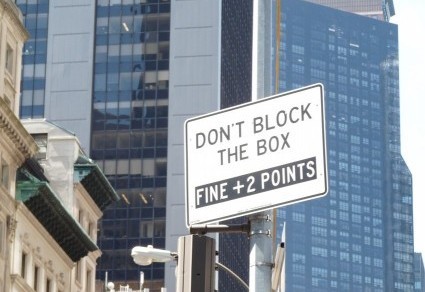
To make matters worse, this beauty stands in front of the United Nations. Can you imagine tooling along First Avenue while decoding these mixed messages in your second or third language? I’d love to know how many people have crumpled fenders because (a) they stopped on the red signal and the car behind did not or (b) they didn’t stop at anytime but the driver in front did.

Not that New Yorkers obey signs all the time:

File under "wishful thinking."

File under “wishful thinking.”


In case you missed the point, the car is blocking the building entrance, which is graced with a sign saying, “Do not block building entrance.” Of course, the driver could always argue (and if a New Yorker, probably does argue) that the building management has no jurisdiction over traffic. Only the cops and the Department of Transportation can regulate pedestrians and vehicles.

Not that others don’t try. One sign, widely mocked and willfully ignored, asked that people waiting at a bus stop not take shelter under the building’s awning or touch the canopy’s vertical supports. Sure. We’ll do that.  Just as soon as it snows in July.

The sign lasted about a month.  If that bus stop were closer to my house, I’d have stood under the awning every day, leaning on the pole, upholding the rights of us peasants.