Category Archives: Snarky Remarks on Grammar

Picky observations on grammar and writing style

Best wishes

In these days of anguish, I’ve noticed many New Yorkers trying harder to take care of each other. On the Third Avenue bus last Saturday night, the driver told departing passengers to “have a very, very, very good evening” or to “be happy, be happy, be extremely happy.” She repeated variations of these statement at each stop with intensity and, as far as I could tell, sincerity. When I got off the bus, she told me to “enjoy, really enjoy” myself. I was grateful for her concern.

Earlier that day, in a pub near the former World Trade Center, the waitress asked my husband and me how “you guys’s day” had been. She really seemed to want to know  and to hope that the answer was “good” or something even more positive.  I spent most of the afternoon trying to decide how to spell what I had heard, which sounded like “you guizes.” The traditional rule for possessive plurals ending in the letter S, such as “guys,” is to tack on an apostrophe after the S. But “you guys” isn’t a traditional plural. Instead, it’s one of the ways New Yorkers indicate that “you” refers to more than one person. (The other common local expression for the plural “you” is “youse” — effective, but not Standard English.) The pronoun you, of course, may be either singular or plural. Lucky waitress: She didn’t have to write down her thoughts or worry about grammar.

That task falls to me. My first idea was “you guys’ day.” That seemed wrong, though, because the pronunciation would be “you guize” — more direct address or a simple plural than possession. I considered writing the phrase as pronounced (“you guizes” or “you guyses”), but then where would I place the apostrophe? And without the punctuation mark, the possessive sense is lost.

I haven’t settled the question, though as you see, I opted for the grammatically incorrect but phonetically accurate “you guys’s.” Your thoughts are welcome — as was the sense of inclusion the waitress was going for. She didn’t want to exclude anyone, a sentiment that, universally applied, would create a better society. And, you guys, we really need that now.

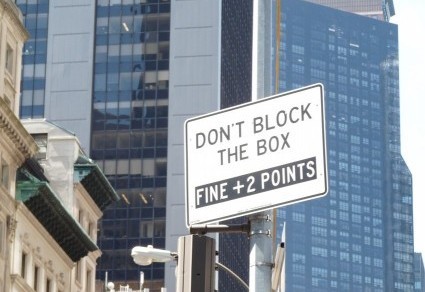
Boxing, New York Style

Manhattan apartments are notoriously tiny, and so are Manhattan closets. So it’s not surprising that during my walks around the borough I encounter many shops offering storage. What is surprising is the nature of that storage. For example:

Legal? Illegal?

Legal? Illegal?


Could be oregano, parsley, or . . . well, I’m sure the DEA would supply a list of herbs that people might want to stash off-site.

And then there’s this beauty:

Put your cold in a box.

Put your cold in a box.

Absent a hyphen, the sign’s meaning is ambiguous. The shop may be offering to store boxes that are low in temperature (cold-box storage). Or, the sign may be targeting sneezers, coughers, and those with similar symptoms (cold box-storage). I know I’d like to stash my ailments at times, especially when I see this sign:

What's free?

What’s free?


I also know, however, that the old adage, “you get what you pay for,” is true. So what’s free: the storage of a box (contents cost extra) or the box (storage charges apply)? I’ll let you know if my kitchen runs out of space and I have to store some herbs, eggs, milk, or anything else.

Stop full stop.

I’m not against periods, the punctuation mark the British call “full stops.” But everything has its place. Traditionally, periods appear at the end of sentences that make statements or give commands. They’re also used in abbreviations. Lately, though, periods have been popping up in odd positions, as in this sign in front of a coffee shop:

And the period is there because?

Why is there a period after “birch”?


The shop’s name is “Birch” — I think. It may be “Birch.” Or is it “Birch. coffee”? And why is the period there at all? Is it supposed to add authority or emphasis? Perhaps the store owner wanted to give a sense of completion, as in “sip your latte here and your life will be complete.” The only thing I know for sure is that the punctuation mark doesn’t indicate a command. (“Hey you! Birch now or face the consequences!) Nor does it end a statement, because there is no statement.

I expect strange things from retailers, but somehow I thought that religious institutions, with help from the Almighty, would do better. At least I thought so until I spied this sign:

This church needs heavenly punctuation guidance.

This church needs heavenly punctuation guidance.


True, this sign contains more words than the café sign, but they don’t form a sentence. The church indeed appears to be “warm, welcoming and beautiful,” but not grammatical.

Nor can you count on the banking system to come to a full stop (in punctuation or in finance):

Two nonsensical, non-sentences appear in one sign.

Two nonsensical, non-sentences appear in one sign.


I don’t expect “pleasure” from my bank. Do you? The “2% cash back” sounds great — but 2% of what? And back to whom? I can’t blame the Great Recession on faulty punctuation, but a lack of clarity in bank communications appears in both. Just saying.

My advice: For a period of time, let’s agree to put a stop to unnecessary full stops. Then we can  decide whether to give this punctuation mark additional duties. That is, “Extra. Duties.”

Contradictory Words

As I worked my leisurely way through the Sunday paper a week ago, one phrase stopped me in my tracks.  The New York Times, which should know better, referred to a “very mediocre” rock band. According to my dictionary, “mediocre” means “moderate” or “not very good.” So “very mediocre” means “very moderate” or “very not very good.” Aren’t you glad I cleared that up? Nice to know that something can be extremely not extreme.

That experience sent me to my picture files, to see whether I had any photos of signs with contradictory meanings. I found this one:

A specialized generalist.

A specialized generalist.


When I was a kid, my doctor was a “general practitioner.” He was good at many areas of medicine, but when things got interesting, he sent me to a specialist. This sign in a 24-hour, no-appointment-necessary, storefront clinic leads me to believe that the “multispecialty physicians” inside are, in fact, the 2016 version of  “general practitioners.” They may have the medical equivalent of several masters degrees, but I doubt it. I’m not complaining about the medical aspect of this sign. The docs inside may provide excellent care. I am complaining about the language, which is much less precise (I hope) than the diagnoses and remedies dispensed  there.

One more example of a contradictory statement comes from an official notice taped to a streetlight on my corner, announcing a public hearing on issues affecting the neighborhood. Here’s item three of the agenda:

Restricted to?

Restricted to?

Turning again to the dictionary, I found that “restricted” means “admitting only members of a particular class.” Thus a street “restricted to” vendors is a street where vendors are allowed — but nothing or no one else. No stores, cars, residents, annoying little kids on scooters — you get the point. I spent the rest of my walk trying to reword the agenda item to reflect the most likely intended meaning: how to keep hotdog carts, ice cream trucks, tables piled with “designer” handbags, and other such vendors off the block. Expressing this idea concisely was surprisingly hard. “Restricted from” doesn’t do the job, nor does “restricted against.” I came up with “barred,” in this revised wording: “Discussion of the process of barring venders from a street.” Alternate versions welcome.

I know I’m being picky (what else is new?), but I do believe that language should be precise. How different would our current political campaign be if every candidate followed this principle, even if their command of the language was “very mediocre”!

New post? Totally.

The recent battle between Apple and the US Department of Justice over an encrypted iPhone was rendered moot when the DOJ figured out how to get into the device without the company’s help. Apple’s argument in favor of privacy would appeal to me more if  I could find a shred of evidence that privacy has not already become a faint, nostalgic glimmer of the past, in the sort of story that old people begin with the phrase “in my day.”

I say this as a frequent customer of the New York City Transit Authority. Consider this incident. Setting: a crowded M15 bus. Characters: Young Mother (YM) with a toddler and an infant, seated in the back. Young Guy (YG) with friends, standing near the front. The dialogue goes like this:

YG: Hey! I haven’t seen you in ages!

YM: I got fired!

YG: You got fired?

YM: Totally.

Keep in mind that this conversation spanned the length of a double bus — the kind of vehicle that bends in the middle to make turns easier. So in effect, the participants were half a block apart. It’s not that getting fired is necessarily — or ever — something to hide. In my day, though, we gave out this information privately, not as a public service announcement. (See what I mean about “in my day”?)

But this isn’t a post about privacy, primarily. Instead it’s about the word “totally.” If YM was “totally fired,” does that mean someone can be “partially fired,” as in “you have to work on Mondays and Wednesdays. You are fired on Tuesdays, Thursdays, and Fridays”? Somehow that scenario doesn’t seem to fit the definition of “fired.”  Instead, “totally” in this context seems to mean “really,” a way to indicate that you meant what you just said. That such an affirmation is necessary is a sad commentary on the status of truth nowadays. (“Nowadays,” but the way, is another favorite word in senior circles.)

My advice: Hit the mute button in your own mouth a little more often, especially in mass transit situations. Then the privacy issue won’t be moot. Not totally, anyway.

Driving yourself crazy

Pity poor New York City drivers, who have to decide where to “pull” their vehicles – over, up, down, and, well, insert the adverb of your choice. Before I go any further, can someone explain why “pull” is the verb here instead of  “steer” or “drive”? Perhaps we are still holding onto the reins of the horsepower in the engine. If so, it is time to let go.

Back to adverbs, the part of speech that tells where the action is. Check out this sign from a parking garage:

Down you go.

Down you go.


In this sign, “down” is an adverb. It must be. If it were an adjective, the driver would have to grab the “down ramp” (not the “up ramp”) and pull it. I rather like this sign.  “Down”  makes sense because the garage is below ground. Also, the sign is polite enough to include “please.”

Here’s another:

Ahead and up.

Ahead and up.


Now the driver is on street level, so “down” is out and “ahead” and “up” are in. Grammatically, there’s no confusion. But one teensy problem remains. The signs in the left lane, where the driver is supposed to “pull ahead” and “up,” hang over cars facing outward. Maybe “ahead” is short for “head-on collision”? You may also be puzzled by the “return” sign, wondering what else you would be doing when you pull into this garage. The only alternative is driving in circles inside the small empty space under the signage. But because the garage is associated with a rental agency, “return” makes sense . . . unless you look at the other two signs, which direct you to the left lane. To sum up: the signs tell you to pull into the right lane to return the car while simultaneously pulling ahead and up in the left lane.

My choice:  Walk. Otherwise, you may drive yourself crazy.

A lie by any other name . . .

A recent reference to “false facts” in an article in my hometown paper, The New York Times, set me to thinking about the ways journalists talk about lies. Given the current presidential campaign, this is a hot topic. My first reaction to “false facts” was that the phrase is an oxymoron . . . a contradiction of itself. If something is false, it’s not a fact. If it’s a fact, it’s not false. Other popular ways to refer to lies are “misstatements,” “misunderstandings,” “exaggerations,” “stretches,” and “wrong impressions” (this last from the liar who says something like “I’m sorry if I gave the wrong impression” when caught).

Despite my reference to lies, I do know that a “false fact” may simply be a mistake, not an attempt to mislead. I am holding onto that belief with both hands lately, with flashbacks to the days when I hoped for, but did not expect, the Tooth Fairy to be real.

Yet how should the media characterize what Politifact (note the name) calls “pants on fire” assertions? One tactic is not to label something as true or false but instead to present information alongside contradictory claims. The problem, of course, is that this approach sometimes leads to the mere appearance of fairness and gives credence to the ridiculous, as in “a member of the Flat Earth Society countered NASA’s claims of that Earth is a spherical planet.”

Nor is the opposite approach perfect. If we rely on pundits to decide what’s factual or fanciful, we’d better make sure that we have great pundits. Extraordinarily wise pundits. Impeccable pundits! All of which are as abundant as unicorns. Complicating the problem, of course, is the fact (and I do assert it as a fact) that many people seek out an expert who will confirm what they already believe.

But this is a post about language, not politics. Back to “false facts”: I’d replace that term with “false information” or “false statements,” with accompanying proof.  And if it’s intentional, I vote for “lie.” This political season, that may be the only choice I have.

Covering Up

The site: an elegant building in midtown with a glassblock wall rising maybe thirty feet, topped by the usual brick construction for many, many feet beyond that. A small patch of greenery, waist-high. In the middle, this paper sign (slightly the worse for wear after a rainy afternoon):

Lean, yes. Sit, no

Lean, yes. Sit, no


The applicable dictionary definition of “façade” is “the face of a building.” Unless you have Spider-Man’s powers, it’s hard to imagine that you can sit on a façade. You can, of course, lean against it, if (in this location) you don’t mind trampling some perfectly innocent ivy.

The second definition of “façade” is “an outward appearance that is maintained to conceal a less pleasant reality.” In a normal election year, I’d mention that politicians lean (as in “rely”) on facades all the time to conceal their “less than pleasant” plans or personality. This particular presidential campaign, though, gives me pause, and not just because I disagree with most policies of many candidates and some policies of all candidates. If this crew is leaning on a façade, it can only be to conceal a more pleasant reality.

With the possible exception of nudist camps, did you ever think you’d miss cover-ups?  Campaign 2016 is indeed different.

Illegal Words

The scene: I’m chopping turnips and listening to my local public radio station. The action: The announcer promises an extended report on “illegal spying” after the break. The reaction: I spend the next ten minutes wondering if “legal spying” exists. The consequences: I  lose a thin slice of fingertip to inattention and have to rinse blood off the turnips. Denouement: I decide that “illegal spying” falls into the same category as “victorious traitor.” If you win, you control the language. That’s why no “traitor” ever gains power. A “traitor” who succeeds is a “rebel” or a “patriot” (see “American Revolution”).  So  James Bond isn’t engaging in “illegal spying” in the eyes of the British government. The nation spied upon, however, holds a different opinion. If James Bond gets caught, he goes to prison. Of course, James Bond never does get caught, not permanently anyway. Why ruin a franchise that reaps billions?

But I digress. This post isn’t about potboiler-blockbusters. It’s about legality and the words that describe it. Take a look at this sign:

P1010935 (3)


These words appear at a construction site, on the side of a shed that protects pedestrians from any falling debris. The ceiling of this shed is maybe twelve or fifteen feet high, level with the apartment windows on the second floor of the building. (How nice for the occupants! They can chat with construction workers over morning coffee.) Back to language: “burglary” is a legal term for breaking and entering a building in order to commit a crime. Okay, that word makes sense, because the shed could facilitate entry into those second-floor apartments. But “hold up”? This is an informal term for “mugging” or any robbery committed with a weapon.  Technically, the same bad guys sneaking through a window could “hold-up” the occupants, but this action is already covered under “burglary.” So why use both terms?

I didn’t lose a fingertip to this one, but I did speculate all the way home. Did the sign-maker envision armed robbers atop the scaffolding, taking wallets and jewelry from residents strolling on top of the shed? For a block or two I decided that the protection was for pedestrians under the shed – a sort of “walk through here and you’ll be safe” notice. Then I realized that “pedestrians” aren’t “premises.” So that theory bit the dust. At the end of the walk, I decided that another definition of “hold-up” worked best: “delay.” This company promises that the building will be “electronically protected” against missing sheetrock, striking workers, and four-hour lunch breaks. Now that is something worth paying for.


Oops, I actually meant that!

In the pre-Internet era, a student-researcher asked me whether New York City maintained “a government suppository of documents.” Yes, I thought, but not in the way you imagine. It’s easy to make fun of misused words, though I believe that kids’ errors should be out of bounds. So with a reasonably straight face, I explained to the young man that “depository” or “repository” would have been a better choice for that sentence.

Politicians and other public figures, however, are fair game when it comes to mockery. I’ve come to believe that when they stray from their speechwriters’ polished prose and venture to express themselves, they sometimes (gasp) reveal what they really think. Call it a Freudian slip, or, in print, a Freudian typo. To be clear, this phenomenon is nonpartisan. The more you talk, the more you slip, regardless of political affiliation.

First up is Sarah Palin’s endorsement of Donald Trump, as reported by my local paper, The New York Times. Referring to the wars in Iraq and Afghanistan, she declared that Americans are “paying for some of their squirmishes that have been going on for centuries.” Squirmishes is a nice blend of two other words. “Skirmish” refers to fights or battles, usually on a small scale and at irregular intervals. “Squirm,” on the other hand, is what you do when you wiggle or twist your body, often because you’re nervous. Was Palin nervous about the endorsement, conflicts in the Arab world, or something else?

Turning again to The New York Times, I found an odd statement from Abraham Foxman, former director of the Anti-Defamation League.  In a lengthy article describing the often tense relationship between President Barack Obama and Prime Minister Benjamin Netanyahu, Foxman was quoted as saying that Obama “bore his soul about how much he cares about Israel.” Three verbs are entwined: bare, bear, and bore. “Bare” is “disclose or uncover”; the past tense is “bared.” “Bear” is “endure, carry a burden.” The past-tense form is “bore.” And of course, “bore” also refers to what politicians do best: make their audiences desperate to change the subject. Now, my question:. Does Foxman think that Obama feels burdened by the US-Israeli relationship or tired of the whole issue?

I know what I think, but I’ll withhold the information to avoid getting into a squirmish.