Tag Archives: English usage

Beware!

As if you didn’t already have enough to worry about, along come a few more things to up your angst level. Take this sign, for example, posted on a construction site near Wall Street:


And here you thought it was enough to educate your kids about sex, drugs, and Internet chat rooms. Hah! Even if you’re far, far away from downtown Manhattan and have no plans to go there, you’re remiss if you don’t sit down with your offspring and explain “the dangers of trespassing on this site” – not the perils of wandering around other sites full of heavy machinery and gaping holes, but definitely this one. Hear that, Tahitians, Alaskans, and  Antarcticans? Tonight, after homework check and before toothbrushing, do your duty.

I confess I still don’t understand what this sign alerts me to, and that fact worries me even more:


Are we talking plutonium here? (And if so, wouldn’t it be “radioactive”?) Sparkling pipes in  cement that can distract you and make you fall flat on your nose? Maybe a Keith Haring drawing of his trademark “radiant child,” formed from neon tubes? You wouldn’t want to walk over a modern masterpiece. Besides,  the two exclamation points imply that radiant tubing is nothing to fool around with. You may suffer unknown consequences if you don’t “beware.” (Make that “beware!”).

I do “beware,” but for safety’s sake I’m not limiting my caution to radiant tubing and construction zones. Here’s my slogan: “Beware of Everything.” Try it. You’ll feel a little anxious, but you’ll be much safer.

Grade: D+

I wrote an earlier post (http://www.grammarianinthecity.com/?p=1012) about a luncheonette interested in hiring a “grilled man” for food prep:

Grilled and Deli Man


Somehow it took the shop owners a long time to find someone suitable. I can’t imagine why.  I also can’t imagine why adding a D where it doesn’t belong is a growing trend. Check out this restaurant’s boast:


I know reality television shows are popular, but I had no idea that food “lived” on television. Do they lock the veggies and chops in a house and film clashes between them? Or drop them in a picturesque spot and vote a certain number of calories off the island each week? I assume the signwriter intended to say “live,” as in “happening now.” But doesn’t the fact that this sign’s been around for months invalidate the whole concept? I stopped in anyway; lunch was delicious.

Another stray D wandered into this sign:


Okay, I can see “specializing” or “specialists.” But “specialized”? The past participle “specialized” implies that the employees used to focus on “hand cleaning & theatrical costumes”  but now have a broader range. Or, they dropped out of the field entirely. And then there’s “hand cleaning.” Don’t most people take care of that chore themselves? Despite the fact that this is a city where many people have breakfast, lunch, and dinner delivered, not to mention laundry and just about every other human need, you’d think hand cleaning would be an in-house job, even if not a personal one. I also note that the cleaners work “on” their “own plants.” Are we talking begonias here? Factories? I’ll figure that one out later. Someone’s coming over now to clean my hands.

Bad Jelly

A while ago a friend sent me a photo that perfectly captures the national mood, or so it seems to me judging by what I read in the paper:


I’m in a “gripe” mood also. So settle in with a little jelly, fellow complainers, and express your own annoyances. Here are three of mine:


It has long been my position that ‘n (intended as a contraction of “and”) is a grunt, not a word. Here it appears with double quotation marks. My advice: If you’re going to butcher a contraction, at least use the proper punctuation to do so. In this case, place an apostrophe before and after the n to indicate that a and d have been dropped.

Next gripe:


I’m a grammarian, not a mathematician, but shouldn’t “Three Cheese Mac & Cheese” be made with three types of cheese? Yet the second line specifies that the dish is “made with American and Swiss Cheese.” I checked the ingredient list, which lists no other identifiable dairy product. I thought about crossing out “three” and penciling in “two,” but I decided that customers, unlike label makers, can count.

One more:


I don’t usually bother with spelling errors, but this one I can’t ignore. Unless they’re trying to exclude everyone except Chicago and Boston baseball professionals, the word is “socks.” Second, even if the sign does refer to the White Sox and Red Sox, you don’t need the final “s.” “Sox” is a plural term. Which makes me wonder what you call a single major leaguer from one of these teams. I can’t imagine an announcer introducing “the next sock at bat.” Baseball fans, feel free to enlighten me, despite the fact that I’ve clearly eaten too much “gripe jelly.”  I think I’ll stick with plain peanut butter for a while, at least until I get my perspective back.

Apostrophes. Sigh.

If I had my way, apostrophes would be exiled from English. My reasons are sound. Many perfectly fine languages do quite well without this punctuation mark. Plus, few people misunderstand the writer’s intended meaning just because an errant apostrophe has crashed a sentence or gone AWOL. Alas, I don’t have my way very often, and never in matters of apostrophes. Perhaps that’s why I seldom bother snapping photos of the many errors I see on signs around New York. But every once in a while, I can’t resist. This sign caught my eye yesterday:


I’m fine with an apostrophe-less “ladies,” because nouns do morph into adjectives at times (e.g. “Yankees baseball”). However, “mens” isn’t a noun. In fact, it’s not even a word. “Men” is an irregular plural, so the only legitimate term is “men’s,” the possessive form. But are the alternatives fair?  You can write “ladies’ & men’s” or “ladies and men” and claim symmetry and equality.  Yet while you might talk about “ladies tailoring” you probably wouldn’t say “men tailoring.” (The technical reason: It doesn’t sound right. Plus, who’s to say that you’re not talking about a guy waving a tape measure around?) Despite the difficulty of fashioning an apostrophe in neon, I think this sign should read  “ladies’ and men’s.”

This sign writer took a different approach:


Fairness demands that because you can have a “man cave,” you should also be able to have a “man shirt.” Working backward on the logic chain to the first sign in this post, you end up with “woman and man tailoring.” I can live with that usage. In fact, I can think of many a woman and man I wouldn’t mind tailoring to my specifications  — talks less, vacuums more, stuff like that. But strict grammarians might object.

One more for (and from) the road:


Why do people keep trying to make plurals with apostrophes? Upstate’s “hen’s” may be the “happiest,” but I bet upstate’s grammarians are pretty glum. They may even be the “unhappiest grammarian’s.”

Whatevers of the World, Unite!

I’ve written before about the modern custom of calling employees anything but. (See http://www.grammarianinthecity.com/?p=546.) Staples has “team members” (with customers as the opponent?) and Walmart has “associates.”  This trend appears to be gaining strength. Note these signs posted in a food store near me:


The first one is a lie, judging by my experience, because the elevator has never actually functioned when I’m in the store. The second seems ominous; crew members entering their “quarters” are really on their way out of the building. Perhaps that’s why the elevator doesn’t work.

But let’s hear it for Starbucks, which displays this chalkboard:

I wonder if this employee’s 401K reflects her status as “partner.”  Somehow I doubt it; in fact, I doubt that she has a 401K or any other retirement plan from the coffee chain. And what’s with “quarter”? They can’t find an employee — sorry — partner of the month? I also like that she’s encouraged to show leadership “through” her peers. “Show through”? Like the crew being shown through the exit?

Lest you think I yearn for simpler times with older terms for workers, I should point out this sign is also problematic:

And the tradeswomen go where?


Leave aside for a moment the fact that “tradeswomen” are out of luck. Focus on the verb. The air of command in “will use” admits no possibility that someone delivering food, services, a baby, or whatever will disobey the sign and enter the same place as the front-door worthy. The sign is prescriptive, yes, but also it presumes to be predictive. Must be nice to see the future so clearly, as a crew member, a partner, a tradesman or a whatever.

A Fog of Words

The city is sitting in a soup of gray fog as I write this post, much like the meaning of these earnest but incomprehensible signs. First up is from a nearby market that prides itself on fair-traded, locally grown, never-met-a-chemical produce:

Whose safety?


Okay, I get that skates inside a store can lead to crashes and possible puncture wounds from organic asparagus. I can also imagine that stepping on a stray artichoke with a bare foot might lead to a deadly collision with a pile of kale or a tub of alfalfa sprouts. But why is a shirt necessary for safety? Perhaps male customers showing off the effects of all those hours with a personal trainer elicit attacks from envious (or lustful) fellow shoppers. And pets? Is the store owner assuming that your poodle, well behaved in your house and on the street, will go berserk and bite you upon seeing the dog biscuit display? What the sign ought to say, I imagine, is that the shirtless, shoeless, pet-ful and skated customers may annoy and, by a long stretch of the imagination, endanger the staff and other shoppers.

The next sign features a word that hasn’t yet made it into the Oxford English Dictionary:


The “clean up” part is clear, even without the smear of what I hope is dirt that a passerby added to a strategic spot on the sign. But what does “leash-curb” mean? Tie Fido to the sidewalk edge? Limit (curb) the length of extendable leashes? I’d support that one in a heartbeat, having tripped or leapt over many a twenty-foot tether.  My guess is that the hyphen is a comma that unwisely flattened out and floated up.

One more, for fans of beauty products:


Are the “50+ ingredients” this store “won’t sell” the appositive of “the finest ingredients” cited in the first line? I can just imagine the manager declaring that “this is the best hand cream in the world, so we don’t carry it and never will.” I’m tempted to go into the store with a list of 50+ ingredients I won’t buy.  That is, I would be tempted if I had the tiniest clue about or interest in body-care ingredients. By the way, I inserted a hyphen to link “body” to “care.” Without the hyphen, the “body” may conceivably be attached to “50+,” in which case you can’t shop here if you’re AARP-eligible.

No Time Like the Future

Does the English language have a future – tense, that is? Most grammarians keep things simple and answer yes. A few, though, see the future as an aspect of present tense, based on the fact that the verb form does not change in a sentence about what has yet to happen, as it does when, for example, “walk” turns into “walked” in a sentence about the past. To talk about the future, the main verb simply acquires “shall” or “will” — helping verbs, in this sort of analysis.

For the record, I think future tense does exist. But I’m intrigued by the philosophical implications of the other way of thinking – that the future, as we conceive it, is solely an aspect of what is happening right now. From that perspective, present actions carry more weight. Or, as thousands upon thousands of coffee mugs put it, “The past is gone. The future has yet to come. Only the present moment is real.” Or something like that.

I thought about future tense when I encountered this sign in the emergency entrance to a hospital:

Will be.


As everyone who’s ever rushed to an emergency room knows, ten minutes of terror precede five hours or so of tedium (if you’re lucky). So I had a lot of time to think about the statement that “the nursing station will be on the left.”  Why not “is”?  Why future tense? Are workers scurrying around with hammers and dry wall, constructing the nursing station as you open the door?

Eventually I realized that the sign speaks to the state of mind of the people who are reading it. Most likely they’re scared because of what’s happening in the present moment and hoping that the moments, hours, days or even years to come will be better.  No general-purpose sign can promise that everything will be all right — not in a hospital. Uncertainty is king. But the sign supplies one small concrete truth to hang onto. Follow the hallway, and the nursing station — and the help it provides — will be on the left. Not much, maybe, but in that moment, that present moment, enough to keep you going.

Being Patient

Every once in a while a word or phrase snags my mind and pulls my attention away from more important things, like oncoming traffic or melting polar ice caps. This message on a sign in front of a medical pavilion caught my eye and took me away, however briefly, from my worries about the serious illness treated there:


I’ll forgo all the jokes about why “patient” is the appropriate term for someone who waits, patiently or not, to see a doctor. The medical personnel I’ve recently gotten to know have a lot of patients — all of which require a lot of patience. Calmly and competently the doctors, nurses, and staff answer questions, soothe fears, and minister to every ailment, taking as much time as the patient, not the doctor, needs.

So I’ll skip the first word on the sign and focus on the rest of it, which at first offended me. It made me think of a loading dock, where things — inanimate objects, not people — are hoisted onto or off of trucks. How demeaning, I thought. But sick people, to an extent, do take on some characteristics of objects. They’re moved around, often without understanding where or why, because their bodies require attention. The normal dignity of adulthood rightly takes a backseat during illness.  Still, “loading and unloading” seems harsh. No one wants to be viewed as cargo.

But what are the alternatives? My first thought was “pick up and drop off.” That wording is not as bad as “loading and unloading,” but it’s far from perfect. “Pick up and drop off” shows up on laundromats and dry cleaners, UPS stores, and so forth. The phrase still conjures up things, just smaller items like packages instead of larger loaded or unloaded crates. (True, kids are picked up or dropped off, but that fact underscores the loss of independence that adult patients experience.)

Nor do longer phrases work for this sign, because drivers need to comprehend the meaning immediately. For this reason I discarded (dropped off? unloaded?) “Stop here only long enough for patients to get out of or into your car.” By the time a driver comes to the end of that sentence, fifteen cars are lined up behind, horns blaring.  Less common phrases have the same problem. Do you want a driver who’s decoding “disembark” or “alight” instead of flicking the signal lever and easing over to the curb?

Nothing I’ve come up with really works, so I’ll have to live with “loading and unloading.” I’m open to suggestions, though. Write when you have time. I can wait. I’m patient.

Bossy

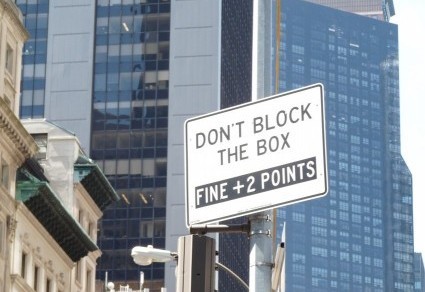
New York signs make a valiant effort to boss people around. Valiant, but futile, as New Yorkers are not known for their unquestioning obedience. Yet the effort continues. Call it faith, if you’re an optimist, or insanity, if you’re not. Here’s an example of bossy New York, in the primary image I chose for this blog:

NYC Block Box Sign


I often wonder whether non-New Yorkers understand this sign, which directs cars to stay out of the intersection (“the box”) when the traffic light turns red. New Yorkers decode it easily; they just choose to ignore it. Effective or not,  this sign is one of my favorites, rivaled only by the classic “Don’t even think of parking here” that sadly has disappeared from the streets of New York. Not that drivers paid attention to that one either.

Recently I snapped photos of two lists of no-nos. Here’s one from a city bus:


Except for the first (littering), riders mostly obey the other prohibitions on this list. I don’t credit the sign, though, because in this day and age, hardly anyone assumes that smoking is allowed on public transit. Spitting is rare because of the gross-out factor.  The last prohibition seems to be a leftover from the boom-box era, when teenagers lugging thirty pounds of technology blasted thumpingly loud music into their fellow riders’ ears.  Even then, those devices were more often playing CD tracks, not radio broadcasts.

The next sign was posted by the management of an apartment building:


When I saw this sign, no one was around, so no one was noncompliant. So is this an effective sign? In my view, no, because of its content.  Maybe a couple of kids gave up ball-playing, but that’s probably because they’d been scolded by someone who didn’t want to listen to the thump of a tennis ball or a Spaldeen (a pink ball essential to stickball, a NY street sport that no one plays anymore because of all the Uber vans clogging the road). Nor does the sign stop “loitering.” That activity disappears naturally because if you stand in one spot, a preoccupied pedestrian is likely to knock you over. Side point: Why specify “sitting in front of building”? Perhaps you’re allowed to sit next to or behind the structure? Or on top of it, if you can get past the doorman? I  agree with the ban on peddling. It’s a well known fact that one sidewalk cart, unopposed, spawns ten more each day, each of which in turn gives rise to ten more, leading to . . . well, you can imagine. But peddlng is, in my opinion, less of a problem for this building than pedaling — bikes criss-crossing the sidewalk and terrifying everyone moving on actual feet.

But carriages? True, strollers increasingly resemble Hummers. I’ve been kneecapped by more than a few baby carriages myself. But seriously — how can you tell parents that their baby’s primary mode of transportation is not welcome?  You may have noticed that the list ends with “under penalty of law.” Illegal baby carriages. Who knew? Unless they’re referring to a Jane Austen sort of carriage? Or the horse-drawn ones that circle Central Park? Not likely.

It seems to me that New Yorkers, with their ingenuity and preference for hanging out (loitering?) on the cutting edge, should be able to come up with a better “don’t” list. Mine isn’t complete, but so far I’ve got cell-phone blathering in crowded areas (especially when it involves relationships, recent surgery, or job complaints),  texting while walking, and bicycling on the sidewalk. What’s on your list? Feel free to send it in. First prize is a boom box with an AM/FM connection, which you can use whenever you sit next to a “no radio playing” sign.

Of Course

I’ve noted before in this blog the gradual disappearance of “you’re welcome” as a response to an expression of thanks.  (See “No Problem? Problem!”  http://www.grammarianinthecity.com/?p=305 ) Lately, because someone I love is ill, I’ve been spending a lot of time in hospital rooms. As dedicated caregivers tend to him — and they are dedicated — I often find myself thanking them. Nearly every one of them replies, “Of course.”

At first I was puzzled by this phrase, but the alternatives don’t really fit. “You’re welcome” — to what? The world of serious illness? No one is welcome there. “No problem.” That’s an obvious nonstarter; everyone in the hospital has plenty of problems. “No worries.” Ditto.

Gradually I’ve come to accept and even like medical substitution of “of course” for “you’re welcome.”  Because what are these people really saying? Of course I will help you with that medicine, give you a clean gown, untangle that tube, whatever. Of course I will answer all your questions. Of course I will speak to the doctor, insurance company, nurse, technician . . . whomever. And when you’re ill, of course you need these things and much more.

Which brings me to the real point. What happens to people who don’t have this attention but need it? I’ve been so immersed in what’s going on in my personal world that I’ve hardly noticed what’s happening in the nation and the world, but I can’t help wondering about those for whom “of course” isn’t the reply they hope or need to hear. I don’t feel bad that my own family receives the best attention and care. I do feel bad that others don’t. And that brings me to this conclusion: Should we do our best for all people who are in tough circumstances? Of course. Whether they say thanks or not.