Tag Archives: signs

Bossy

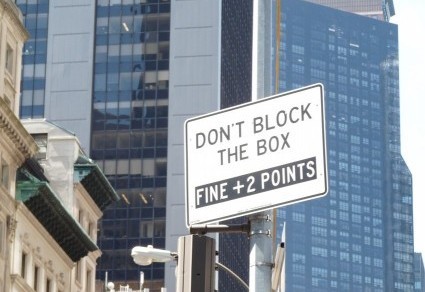
New York signs make a valiant effort to boss people around. Valiant, but futile, as New Yorkers are not known for their unquestioning obedience. Yet the effort continues. Call it faith, if you’re an optimist, or insanity, if you’re not. Here’s an example of bossy New York, in the primary image I chose for this blog:

NYC Block Box Sign


I often wonder whether non-New Yorkers understand this sign, which directs cars to stay out of the intersection (“the box”) when the traffic light turns red. New Yorkers decode it easily; they just choose to ignore it. Effective or not,  this sign is one of my favorites, rivaled only by the classic “Don’t even think of parking here” that sadly has disappeared from the streets of New York. Not that drivers paid attention to that one either.

Recently I snapped photos of two lists of no-nos. Here’s one from a city bus:


Except for the first (littering), riders mostly obey the other prohibitions on this list. I don’t credit the sign, though, because in this day and age, hardly anyone assumes that smoking is allowed on public transit. Spitting is rare because of the gross-out factor.  The last prohibition seems to be a leftover from the boom-box era, when teenagers lugging thirty pounds of technology blasted thumpingly loud music into their fellow riders’ ears.  Even then, those devices were more often playing CD tracks, not radio broadcasts.

The next sign was posted by the management of an apartment building:


When I saw this sign, no one was around, so no one was noncompliant. So is this an effective sign? In my view, no, because of its content.  Maybe a couple of kids gave up ball-playing, but that’s probably because they’d been scolded by someone who didn’t want to listen to the thump of a tennis ball or a Spaldeen (a pink ball essential to stickball, a NY street sport that no one plays anymore because of all the Uber vans clogging the road). Nor does the sign stop “loitering.” That activity disappears naturally because if you stand in one spot, a preoccupied pedestrian is likely to knock you over. Side point: Why specify “sitting in front of building”? Perhaps you’re allowed to sit next to or behind the structure? Or on top of it, if you can get past the doorman? I  agree with the ban on peddling. It’s a well known fact that one sidewalk cart, unopposed, spawns ten more each day, each of which in turn gives rise to ten more, leading to . . . well, you can imagine. But peddlng is, in my opinion, less of a problem for this building than pedaling — bikes criss-crossing the sidewalk and terrifying everyone moving on actual feet.

But carriages? True, strollers increasingly resemble Hummers. I’ve been kneecapped by more than a few baby carriages myself. But seriously — how can you tell parents that their baby’s primary mode of transportation is not welcome?  You may have noticed that the list ends with “under penalty of law.” Illegal baby carriages. Who knew? Unless they’re referring to a Jane Austen sort of carriage? Or the horse-drawn ones that circle Central Park? Not likely.

It seems to me that New Yorkers, with their ingenuity and preference for hanging out (loitering?) on the cutting edge, should be able to come up with a better “don’t” list. Mine isn’t complete, but so far I’ve got cell-phone blathering in crowded areas (especially when it involves relationships, recent surgery, or job complaints),  texting while walking, and bicycling on the sidewalk. What’s on your list? Feel free to send it in. First prize is a boom box with an AM/FM connection, which you can use whenever you sit next to a “no radio playing” sign.

New Year’s Hodgepodge

The definition of “hodgepodge” — a great word if ever there was one — is “a confusing mixture.” Life feels like a hodgepodge these days, but laughter is an essential reaction to any absurd or difficult situation. In that spirit, here’s a New Year’s hodgepodge of incomprehensible New York City signs. First up is an example of over-eager punctuation:

Really not allowed. Really a bar. Thanks you for asking.


I’m guessing a nervous owner is aiming for an emphatic tone. If so, mission accomplished. But why? Do people bring their dogs, cats, boa constrictors, parrots and any other NYC pets (and by the way, I’ve seen all of these at one time or another on city streets) into the store if only one exclamation point appears? And what’s with the underlined “bar”? Wouldn’t “open” be the more relevant word? Unless there’s a secret message (martinis available here, disguised as “food”)?

Friendly is good, right? Maybe not in this context, though:

Friendly to what?


Is this product “friendly” to the conditions (asthma, allergy) or to those who have them? I’m assuming the latter, but the sign is ambiguous at best. And it’s trademarked! You’d think the sign-writer/trade-marker would check with a grammarian before signing off (pun intended) on this slogan.

Next up is a salon sign offering a very specific service:

Who’s counting?


I’m not really sure what “Natural Lash Extns.” are, and I’m very sure I don’t want to find out via personal experience. My real question concerns the number. Is someone sitting there counting? Do lashes come in numbered sets? And why 90? Is 75 too little? Inquiring minds want to know.

And while I’m on the subject of numbers, I’ll end this hodgepodge with a number of my own: 2017. I hope it’s a happy, healthy year for all of you.

Grammarian in a Different City

I spent the last two weeks as a grammarian in three different cities — Madrid, Granada, and London. Far be it for me to write about Spanish signs, even those translated into English. How could I criticize, given that I wrote the Spanish equivalent of “pitifully, I can’t meet you for dinner” in response to an invitation from a friend? Nor would I dare take on the British. More than two centuries after the colonies declared independence, some Americans — including me — still harbor the idea that English in the Mother Country is superior.

I did notice one or two signs in London, on the window of a shop selling bespoke umbrellas and other, more unusual merchandise:

Paging James Bond.

Paging James Bond.


I go to this shop every time I’m in London, not to buy but to gape. I haven’t yet had the nerve to ask how “dagger canes” differ from “swordsticks,” but if I did, I’m sure one of the extremely helpful employees would explain. Nor have I glimpsed any “life preservers,” unless umbrellas sturdy enough to protect you in a flash flood rate that designation. What interests me about this sign is the punctuation — commas after the first two items and a period (“full stop,” in British English) after the last. Contemporary sign-makers on either side of the Atlantic seldom bother to insert commas. Periods, on the other hand, are trendy. (See “Stop Full Stop” at  http://www.grammarianinthecity.com/?p=1364 for more on this subject). But commas and periods together in a sign? Unprecedented, at least for me.

My first thought was that this punctuation reflected a different era, as indeed the store itself does:

Late of Saville Place.

Late of 1, 2, & 3 Saville Place.


In fact, the sign understates the store’s age; it was “estd” in 1830. I have no basis for comparison, though, as I was unable to find other signs from the same era.

However, conventions of language tend to be supported by some sort of rationale. I considered the sign again and decided that the commas may be separating items in a list, which ends with a period. In that case, though, I’d expect a conjunction (probably “and”) before “swordsticks.”  Furthermore, I wouldn’t expect to find a comma preceding the conjunction — not in Britain. That last comma usually shows up in American lists but not in British lists. It’s called “the Oxford comma” in Britain and, sometimes, “the Harvard comma” in the United States. (Perhaps “ivy comma” should be the universal, trans-Atlantic term?)  I finally concluded that the comma between “dagger canes” and “swordsticks” substitutes for the conjunction. There’s a comma before the implied “and” because “and” isn’t on the sign. This theory makes sense to me, but I’m open to other interpretations.

Regardless of punctuation, do visit this shop if you’re ever in London. The life you preserve may be your own.

When?

Common wisdom holds that “it’s all in the timing.” Fine. But what time are we talking about? Here’s a sign I saw on the window of a bar:

So polite! And a semicolon, too.

So polite! And a semicolon, too.


The image is a little blurry, so I’ll repeat the message here: “Please respect our neighbors; try to avoid loud talking after a certain time. Merci. Amelie.” The courtesy is impressive, and the punctuation flawless. My only problem: When is “after a certain time”? Noon? Midnight? Now?

Here’s another, posted on the door of a construction shed:

Use it permanently.

Temporarily.


I think we can all agree that walking into “heavy demolition” is a bad idea. I’d have no problem with “Do not use this doorway until further notice” or simply “Go Away! Heavy Demolition!” What I don’t get is the concept of “temporarily.” Can you use this doorway permanently? If there’s heavy demolition going on, “permanently” for anyone who uses the doorway may be a very short period of time.  Amelie, the bar owner, would probably say, “Do not use this doorway until a certain time.”

Speaking of time, it’s time for my vacation. Woods out — temporarily.


April Fool

Slightly out of season, I know, but like most New Yorkers, I’ve spent this August dreaming of a time when the city wasn’t wrapped in a blanket of hot, wet air. Specifically April, when I snapped these photos and mentally placed them in the “April Fool” category, though I’m fairly certain the creators thought their signs were models of clarity. First up is a statement about a mysterious “shirt machine”:

How are your shirt conditions?

How are your shirt conditions?


I’d probably be tempted to use this device if my clothing were in good “conditions.” But my tees and blouses currently feature sweaty patches, grass stains, and one blob of what may be somebody’s used chewing gum. I’m not interested in keeping those conditions “better and longer” or, for that matter, keeping them at all.

From the next sign I learned that the city has a “Business Integrity Commission.” Great. If only NYC had a grammar commission as well:

Recycling what?

Recycling what?


Absent punctuation, the establishment is “recycling used cooking oil services.” How exactly do you recycle “services”? And did someone call a hyphen strike without informing me? I’d rewrite the sign this way: “Bio Energy Development, Inc. recycles used cooking-oil from this establishment.”

One more, also punctuation-challenged:

Refinish repair?

Refinish repair?

As written, the shop is offering “restoration” of antique furniture. They also do “caning,” which has nothing to do (I think) with corporal punishment and instead involves weaving strips of stiff grass into a chair seat. So far, so good. Both services are nouns, and both may apply to antique furniture.

Where I crash and burn is “refinish repair,” which seem to be verbs in this context. Is the store refinishing something it had previously repaired, or are they refinishing and repairing upholstery? If so, a couple of -ing syllables would be helpful. Also, is it possible to “refinish” upholstery? Paging furniture specialists! Send in your clarifications, please. While I wait to hear from you, I’ll dream of cooler days.


Thanks for nothing

Recently I took advantage of New York City’s IDNYC program, which gave me an official photo ID and a raft of free membership offers to some of the city’s best museums. In redeeming one of those membership offers at an institution I won’t embarrass by naming, I received an email thanking me for my “contribution of $0.00” and telling me that donations such as mine “support the work of the museum.” If that’s true, the museum is probably nearing bankruptcy. Continue reading

Magritte in NYC

On this Bastille Day, I am pleased to report that Rene Magritte is alive and well and creating art in New York City:

"Ceci n'est pas une 'bike stand.'"

“Ceci n’est pas une ‘bike stand.'”


For the sake of comparison, here is one of Magritte’s earlier works:

To see the original, go to Los Angeles.

To see the original, go to Los Angeles.


In case you’re wondering about the power of art, I staked out this spot for a while, to see whether a bicycle would be chained to it.  New Yorkers do sometimes interpret a prohibition as a dare. But no bikes appeared. Either the sign is very effective or the glowering shop owner, who was standing next to this tree every time I passed, scares cyclists into compliance. Either way, enjoy Bastille Day. (Especially you, Don and Avram, my art historian friends.)

Ritual Pick-Up

I spotted this sign in a food court near Battery Park in Lower Manhattan. I lurked for a while, hoping to see what sort of customers or services were associated with it. But it was a holiday weekend, when most New Yorkers were anywhere-but-here, so I was left alone with my speculations.

Rituals, outsourced.

All I wanted was coffee.


First, I concentrated on “ritual.” This is a city with its own unit of time — a “New York minute,”  which lasts only a couple of nanoseconds and which a comedian once defined as “the interval between the traffic light turning green and the guy behind you honking his horn.” To save time, New Yorkers will do almost anything. So, I reasoned, if you’re too busy to plan, say, a wedding ceremony, a baptism, or a bar mitzvah, you can pick one up here. And if the timing is right, your next life event may even be on sale.

Then I shifted my attention to “pick-up.” Perhaps, I thought,  this is where you meet when you’ve donned your sexiest outfit, artfully mussed your hair, and practiced lines like “Come here often?” or “What’s your sign?” or “Has anyone ever told you that you have beautiful eyes/great abs?” Nice to know that the hackneyed has an official spot in NYC, I thought.

A quick Internet search revealed that an app called “Ritual” allows you to order and pay for food online, which you then pick up at this location. Efficient and useful, true, but much less fun than my interpretations.


Boxing, New York Style

Manhattan apartments are notoriously tiny, and so are Manhattan closets. So it’s not surprising that during my walks around the borough I encounter many shops offering storage. What is surprising is the nature of that storage. For example:

Legal? Illegal?

Legal? Illegal?


Could be oregano, parsley, or . . . well, I’m sure the DEA would supply a list of herbs that people might want to stash off-site.

And then there’s this beauty:

Put your cold in a box.

Put your cold in a box.

Absent a hyphen, the sign’s meaning is ambiguous. The shop may be offering to store boxes that are low in temperature (cold-box storage). Or, the sign may be targeting sneezers, coughers, and those with similar symptoms (cold box-storage). I know I’d like to stash my ailments at times, especially when I see this sign:

What's free?

What’s free?


I also know, however, that the old adage, “you get what you pay for,” is true. So what’s free: the storage of a box (contents cost extra) or the box (storage charges apply)? I’ll let you know if my kitchen runs out of space and I have to store some herbs, eggs, milk, or anything else.

Contradictory Words

As I worked my leisurely way through the Sunday paper a week ago, one phrase stopped me in my tracks.  The New York Times, which should know better, referred to a “very mediocre” rock band. According to my dictionary, “mediocre” means “moderate” or “not very good.” So “very mediocre” means “very moderate” or “very not very good.” Aren’t you glad I cleared that up? Nice to know that something can be extremely not extreme.

That experience sent me to my picture files, to see whether I had any photos of signs with contradictory meanings. I found this one:

A specialized generalist.

A specialized generalist.


When I was a kid, my doctor was a “general practitioner.” He was good at many areas of medicine, but when things got interesting, he sent me to a specialist. This sign in a 24-hour, no-appointment-necessary, storefront clinic leads me to believe that the “multispecialty physicians” inside are, in fact, the 2016 version of  “general practitioners.” They may have the medical equivalent of several masters degrees, but I doubt it. I’m not complaining about the medical aspect of this sign. The docs inside may provide excellent care. I am complaining about the language, which is much less precise (I hope) than the diagnoses and remedies dispensed  there.

One more example of a contradictory statement comes from an official notice taped to a streetlight on my corner, announcing a public hearing on issues affecting the neighborhood. Here’s item three of the agenda:

Restricted to?

Restricted to?

Turning again to the dictionary, I found that “restricted” means “admitting only members of a particular class.” Thus a street “restricted to” vendors is a street where vendors are allowed — but nothing or no one else. No stores, cars, residents, annoying little kids on scooters — you get the point. I spent the rest of my walk trying to reword the agenda item to reflect the most likely intended meaning: how to keep hotdog carts, ice cream trucks, tables piled with “designer” handbags, and other such vendors off the block. Expressing this idea concisely was surprisingly hard. “Restricted from” doesn’t do the job, nor does “restricted against.” I came up with “barred,” in this revised wording: “Discussion of the process of barring venders from a street.” Alternate versions welcome.

I know I’m being picky (what else is new?), but I do believe that language should be precise. How different would our current political campaign be if every candidate followed this principle, even if their command of the language was “very mediocre”!